


Top 5 Automatic Poultry Equipment Systems for Large-Scale Chicken Farms
Quick answer: For most large-scale layer and broiler projects, the five highest-priority automatic poultry equipment systems are the chicken cage system, automatic feeding system, automatic drinking system, automatic manure removal system, and poultry-house climate control system. This ranking is based on production impact, labor-saving potential, biosecurity value, system compatibility, maintenance needs, and long-term operating value. Large farms generally benefit from a coordinated high-automation solution, while smaller projects may adopt these systems in phases according to budget, power reliability, and management capacity.
Choosing poultry equipment is not simply a matter of comparing individual machines. A commercial farm performs best when housing, feed, water, manure, and environmental control operate as one coordinated production system. The right configuration depends on poultry type, target capacity, local climate, electricity conditions, available labor, poultry-house dimensions, and future expansion plans.
Comparison of the Top 5 Automatic Poultry Equipment Systems
| Rank | Product or System | Best For | Automation Level | Main Advantage |
|---|---|---|---|---|
| 1 | Automatic chicken cage system | Commercial layer and broiler farms | Medium to high | Organizes birds and integrates farm operations |
| 2 | Automatic feeding system | Medium and large farms with long cage rows | High | Consistent feed delivery with less labor |
| 3 | Automatic drinking system | Layer, broiler, and pullet projects | Medium to high | Controlled access to clean water |
| 4 | Automatic manure removal system | Multi-tier and intensive poultry farms | High | Cleaner houses and organized waste handling |
| 5 | Poultry-house climate control system | Enclosed houses and challenging climates | High | Stable temperature, humidity, and air quality |
This ranking is a project-selection guide based on the criteria explained below. It does not represent an official market-share ranking.
How We Ranked the Equipment
We assessed each system by its effect on daily production, bird management, space utilization, labor requirements, maintenance complexity, climate adaptability, expansion flexibility, compatibility with other equipment, and total cost of ownership. Buyers should compare complete operating value rather than initial price alone. A low-cost component can become expensive if it causes uneven feeding, water leakage, excessive waste, difficult maintenance, or frequent downtime.
1. Automatic Chicken Cage System
The chicken cage system is the structural core of an intensive poultry farm. It determines stocking layout, aisle arrangement, equipment positioning, inspection access, manure handling, and the level of automation that can be added.
Best applications and advantages
- Commercial layer farms requiring organized egg production and efficient inspection.
- Broiler projects seeking structured flock management and efficient use of house space.
- Farms with limited land but a relatively high target capacity.
- Projects planning centralized feeding, drinking, manure removal, egg collection, and monitoring.
Multi-tier configurations can increase space utilization, while standardized rows simplify the integration of other automatic poultry equipment. Depending on project needs, Livi Machinery can configure A-type or H-type cage systems for layers, broilers, and pullets.
Limitations and maintenance
Cage dimensions and tier configurations must match the poultry-house width, height, ventilation design, bird type, and applicable local requirements. Installation accuracy is essential because misalignment can affect feeding equipment, manure belts, and egg conveyors. Buyers should inspect fasteners, wire surfaces, moving interfaces, and corrosion-prone areas according to the supplier's maintenance plan.
Why it ranks first: Every supporting system is designed around the housing layout. A project-specific 2D or 3D plan is therefore more useful than a cage-only quotation.
2. Automatic Feeding System
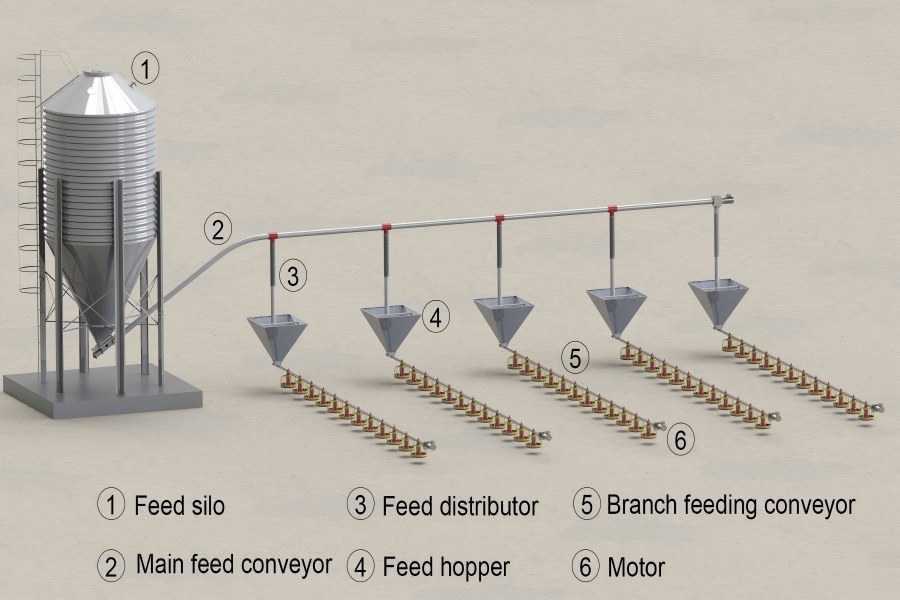
An automatic feeding system transfers feed from storage or a hopper to each cage row or feeding line. It is recommended for farms where manual feeding consumes excessive time or produces inconsistent distribution.
Core selection points
Buyers should compare delivery capacity, line length, motor specifications, conveying method, feed characteristics, control method, and access to replacement parts. Correct calibration helps provide more consistent distribution and can reduce unnecessary feed handling.
Possible limitations
Moving parts, chains, hoppers, sensors, and drive units require regular inspection. Poor calibration or an incorrectly sized motor may cause uneven delivery. Farms in areas with unstable electricity should include a practical backup-power and manual-response plan.
Why it ranks second: Feed is handled every day, so reliable automation can remove a large amount of repetitive work and support more standardized flock management.
3. Automatic Drinking System
The drinking system distributes water through regulated lines, usually using filters, pressure regulators, pipes, and nipple drinkers. Stable water access directly supports feed intake, growth, laying performance, and flock health.
Core selection points
- Test water quality before finalizing filtration and flushing requirements.
- Match operating pressure and nipple flow to the bird type and production stage.
- Design line height, pipe slope, and end-of-line flushing access correctly.
- Prepare routine procedures for cleaning mineral deposits and biofilm.
Possible limitation: Incorrect pressure can produce leakage or inadequate flow. System performance therefore depends on commissioning, water treatment, and routine inspection.
Why it ranks third: It operates continuously and influences almost every aspect of flock performance, while requiring relatively little labor after proper setup.
4. Automatic Manure Removal System
An automatic manure removal system uses belts, scrapers, conveyors, or combined mechanisms to move manure out of the bird area. It is particularly valuable in multi-tier cage houses where manual removal is impractical.
Main advantages
Frequent removal limits the time manure remains inside the poultry house, reduces manual cleaning, and supports more organized storage or treatment. It can also help the farm manage odor, moisture, and the working environment when coordinated with ventilation and drinking systems.
Possible limitations and maintenance
Belt alignment, tension, scraper adjustment, bearings, and drive units need scheduled checks. The discharge point must match the site's manure storage, drying, composting, or treatment plan. Wet manure may indicate a drinking-system leak, excessive humidity, or insufficient ventilation rather than a manure-system fault.
Why it ranks fourth: It connects hygiene, labor efficiency, and waste management, making it a core component of intensive poultry production.
5. Poultry-House Climate Control System
A climate control system coordinates ventilation fans, cooling pads, heating equipment, air inlets, sensors, alarms, and controllers to manage temperature, humidity, airflow, and air quality.
Best applications
Climate control is essential for enclosed houses, high-density projects, and locations with hot, humid, cold, or highly variable weather. High-temperature regions may prioritize negative-pressure fans, cooling pads, drinking reliability, and backup electricity. Cold regions require a balance among insulation, heating, minimum ventilation, and energy use.
Possible limitations
A standard list of fans and cooling pads cannot replace a project-specific ventilation calculation. Building sealing, insulation, inlet positioning, sensor placement, controller settings, and power reliability all influence performance.
Why it ranks fifth: Although it is listed fifth, it can be mission-critical in challenging climates. Its exact priority depends heavily on location and poultry-house design.
Best Options for Different Farm Sizes
- 10,000–20,000 birds: Consider an A-type cage layout, a reliable drinking system, basic manure handling, and phased automation where appropriate.
- 20,000–50,000 birds: Compare A-type and H-type systems according to land, labor, power, and budget; automatic feeding and manure removal become increasingly valuable.
- 50,000–100,000 birds: An H-type cage system with automatic feeding, manure-belt removal, egg collection for layers, and environmental control is often more suitable, subject to project design.
- More than 100,000 birds: Evaluate a complete solution including centralized feed handling, egg collection where applicable, enclosed poultry houses, climate control, monitoring, and backup power.
How to Choose the Right Poultry Equipment Supplier
Before requesting a final quotation, prepare the project country and city, poultry type, target bird capacity, land size, poultry-house dimensions, local climate, available electricity, preferred automation level, budget range, manure plan, and expansion target.
A qualified poultry equipment supplier should translate this information into a coordinated layout, equipment list, utility requirements, shipping plan, installation scope, and commissioning process. Compare warranty terms, technical drawings, operator training, spare-parts supply, installation guidance, and after-sales response in addition to price.
Frequently Asked Questions
What equipment is essential for a poultry farm?
The essential systems are suitable housing or cages, feeding, drinking, manure handling, and environmental control. Layer projects may also require automatic egg collection, depending on capacity and automation goals.
Which chicken cage system is best for layer farming?
There is no single best system for every farm. A-type cages can suit projects requiring simpler operation or phased automation, while H-type cages are generally more suitable for higher-density and highly automated projects, subject to house dimensions and budget.
How much does automatic poultry equipment cost?
Cost depends on bird type, capacity, cage configuration, house dimensions, automation level, materials, electrical standards, shipping, and installation scope. An accurate price requires a project-specific equipment list and layout.
Can automatic poultry equipment work where electricity is unstable?
Yes, but the project should include backup power, alarms, emergency procedures, and carefully selected automation. Ventilation, water supply, and control systems require particular attention because interruptions can quickly affect the flock.
Can poultry equipment be customized?
Yes. Livi Machinery can configure cage systems and supporting equipment according to country, climate, bird type, target capacity, poultry-house dimensions, electricity conditions, labor, and budget.
Does Livi Machinery provide installation support?
Installation scope should be confirmed for each project. Available project support can include equipment configuration, 2D and 3D layouts, shipping coordination, installation guidance, training, commissioning assistance, and after-sales service.
What information is needed for a poultry farm quotation?
Provide the country and project location, poultry type, target capacity, house dimensions, land size, local climate, electricity conditions, required automation level, and budget range. Photos or drawings of an existing house are also useful.
Build the System Around Your Farm
The best automatic poultry equipment is the equipment that works together under the real conditions of the project. Zhengzhou Livi Machinery Equipment Co., Ltd. provides project-based solutions covering A-type and H-type cage systems, feeding, drinking, manure removal, egg collection, ventilation, environmental control, steel-structure poultry houses, layout design, and project support.
To receive a customized equipment list, poultry-house layout, and quotation, share your country, project location, poultry type, target bird capacity, house dimensions, local climate, electricity conditions, required automation level, and budget range with the Livi Machinery team.

养鸡场建设:单机采购与整场一站式解决方案的成本与风险对比

建设现代化蛋鸡养殖场需要配置哪些核心系统
海外规模化养鸡场项目:从场地评估到安装调试的交付要点

尼日利亚70,000只蛋鸡H型层叠式鸡笼项目案例
家禽养殖一站式交钥匙工程是什么:从场地规划到养鸡场交付全流程
热门产品

.jpg?x-oss-process=image/resize,m_fill,h_800,w_800/format,webp)


准备好开始了吗?
准备好建造您的家禽养殖场了吗?
告诉我们您的土地面积、家禽品种和养殖规模。LIVI 将为您的项目提供完整的农场解决方案。