


Building a Poultry Farm: Why Equipment Price Alone Is Not a Complete Procurement Decision
When building or upgrading a commercial poultry farm, the lowest equipment price is easy to compare—but it is rarely enough to make a complete procurement decision. In real projects, outcomes depend on how well systems match, how smoothly delivery and installation are coordinated, and how reliably the farm can operate at scale.
This page provides a practical procurement checklist for investors and project managers. It also compares standalone equipment purchasing versus choosing an integrated/turnkey supplier—with a focus on system compatibility, automation level, fulfillment and logistics, technical support, and total cost of ownership.
Why “Lowest Price” Often Becomes the Most Expensive Choice
Poultry farming equipment is not a single item purchase—it is a production system. A low unit price can be offset by hidden costs such as mismatched interfaces, rework during installation, delays from split shipments, or inefficiencies that increase labor and operating cost over time.
- Different suppliers may use incompatible specifications, making integration slower and riskier.
- Automation performance depends on system matching (feeding, drinking, manure removal, egg collection, and environmental control).
- Delivery coordination and on-site readiness often determine whether the farm starts on schedule.
- After-sales responsiveness impacts downtime and operating stability.
Standalone Purchases vs. Turnkey/Integrated Procurement
Many farms consider buying cages and auxiliary systems separately to compare prices. Others prefer an integrated supplier to reduce coordination risk. The right approach depends on your project team capacity, schedule, and required automation level.
| Decision Dimension | Buying Individual Equipment | Integrated / Turnkey Supplier |
|---|---|---|
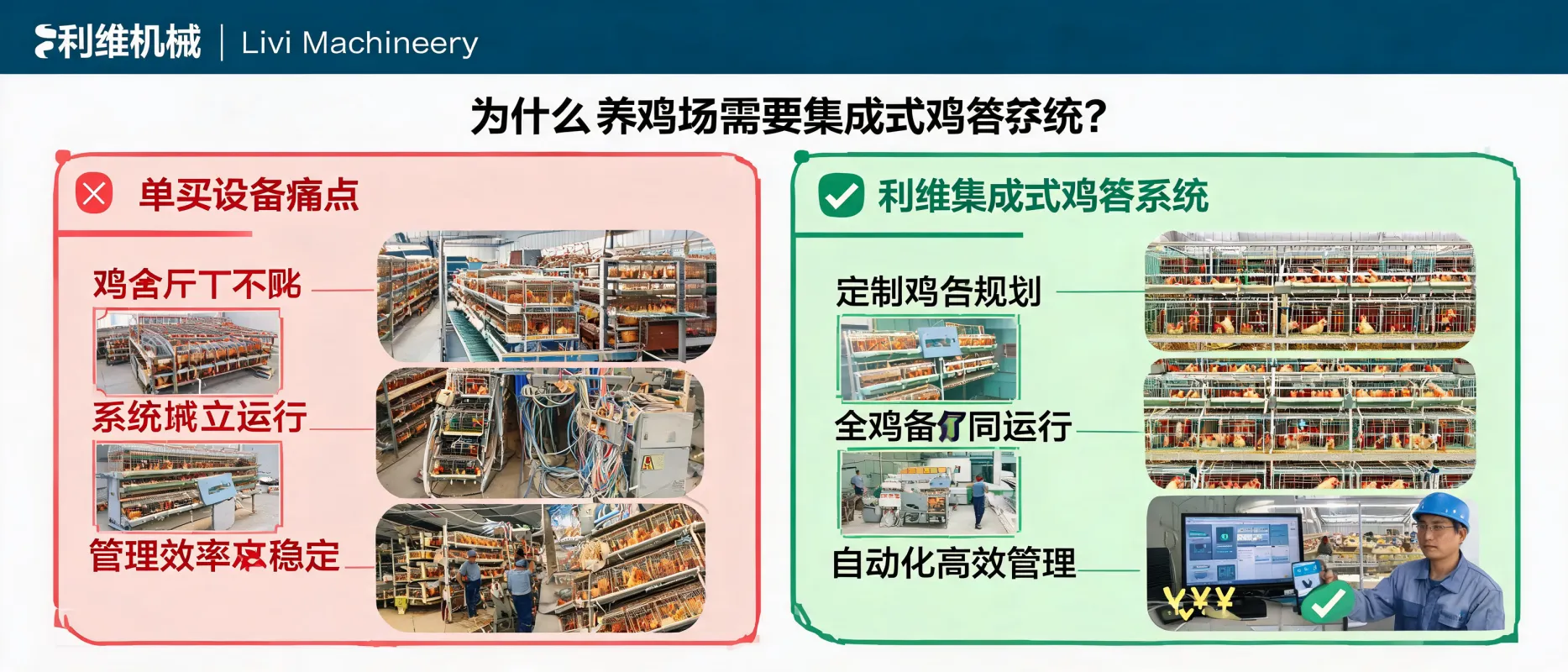
| System compatibility | Requires strong internal engineering; higher risk of interface mismatch | Unified design logic can reduce integration friction |
| Project coordination | Multiple vendors; schedule and accountability are harder to manage | One coordination window for procurement, shipment, and on-site sequencing |
| Automation level | May vary by subsystem; performance consistency depends on integration | Automation is designed as a whole (feeding/drinking/manure/eggs/climate) |
| Fulfillment & logistics | Split shipments increase customs, packing, and delivery complexity | Consolidated delivery planning can reduce on-site waiting and missing parts |
| After-sales support | Responsibility may be unclear across multiple suppliers | Clearer service scope; easier troubleshooting for system issues |
| Total cost of ownership | Lower upfront line items may hide higher integration & operating costs | Often better for controlling long-term operational stability and labor needs |
Procurement success is not “buying cheaper equipment”—it is achieving stable production with manageable operating cost and predictable maintenance.
A Total Procurement Checklist for Commercial Poultry Farms
1) System matching & engineering fit
- Define your farm type (layer/broiler) and capacity goals before selecting models and configurations.
- Check interface compatibility across cages, feeding, drinking, manure removal, egg collection (layers), and house control.
- Confirm layout constraints (house dimensions, aisle spacing, service access) to avoid installation rework.
2) Automation level & operating labor
- Evaluate what will be automated: feeding, nipple drinking lines, manure removal, egg collection, and environmental control.
- Clarify your staffing plan and maintenance capability—automation should match operator skill and spare parts readiness.
- Ask how the system supports stable daily routines (cleaning, inspection, and fault handling).
3) Delivery coordination & on-site installation readiness
- Request a delivery and packing list aligned with the installation sequence to prevent missing key components on site.
- Confirm lead times, shipment consolidation plans, and on-site unloading/handling requirements.
- Plan for installation guidance, safety requirements, and commissioning checkpoints.
4) Technical support & after-sales response
- Define support scope: remote guidance, troubleshooting process, and spare parts recommendation.
- Establish response expectations for operational questions—especially during startup and ramp-up.
- Ensure documentation is clear: manuals, wiring/assembly instructions, and maintenance guidance.
5) Total cost of ownership (TCO), not only purchase price
Compare options using a full cost view: equipment + logistics + installation coordination + operating labor + downtime risk + maintenance planning.
- What costs increase if different suppliers’ systems don’t align?
- What is the impact of delays on farm start-up and production schedule?
- How will spare parts and maintenance be handled over time?
What Livi Machinery Provides in an Integrated Poultry Farm Solution
Livi Machinery (Zhengzhou Liwei Machinery Equipment Co., Ltd.) is a poultry farming equipment and solution provider serving large commercial markets across Africa, the Middle East, Southeast Asia, South America, Central Asia, and Europe. We supply core systems commonly required for scalable farms, and we support projects that prefer an overall plan-to-delivery approach.
Typical equipment scope (select by project needs)
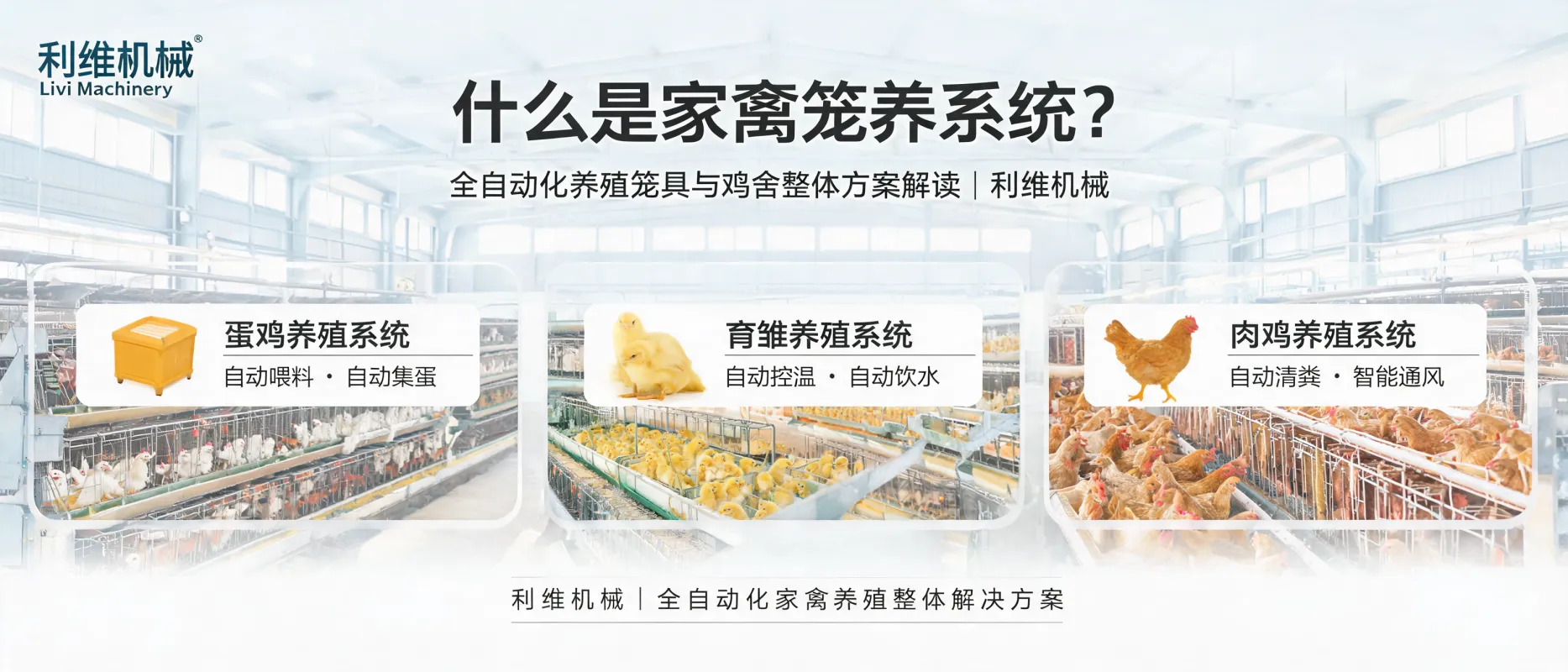
- layer cages, broiler cages, brooding & rearing cages
- Automatic feeding system and automatic drinking system
- Automatic manure removal system and automatic egg collection system (for layer farms)
- Poultry house environmental control equipment
- Steel structure poultry house and supporting equipment for large-scale farms
Fulfillment options for different markets
To fit different project timelines and local conditions, Livi Machinery can support multiple fulfillment approaches depending on the region and cooperation model:
- Direct shipment
- Local production (where applicable)
- Overseas warehouse supply
- Local distribution through partners
Service attitude & communication
With an experienced team focused on customer service and technical support, we aim to respond to inquiries within 3 hours to help project teams move faster in decision-making and coordination—especially during the planning and startup stages.
How to Use This Checklist in Your Next RFQ
- List your required subsystems (cages + feeding + drinking + manure + egg collection + environmental control) and define the target automation level.
- Request a matching plan: layout assumptions, interface notes, and a delivery/installation sequence proposal.
- Compare offers by system fit, coordination responsibility, fulfillment reliability, and service support—then evaluate the total cost of ownership.
- Choose the procurement model that best fits your internal project management capacity and schedule risk tolerance.
For project teams that want fewer handoffs
If your priority is stable delivery, clear coordination, and scalable farm operation, an integrated procurement approach can reduce uncertainty—especially for large layer/broiler projects.
Talk to Livi Machinery
Share your farm type, capacity target, country/region, and preferred fulfillment model. We will help you review system matching and procurement risk points—so your decision goes beyond equipment price alone.


Hot Products

.jpg?x-oss-process=image/resize,m_fill,h_800,w_800/format,webp)


Popular articles




READY TO START?
Ready to Build Your Poultry Farm?
Tell us your land size, poultry type and farming capacity. LIVI will provide a complete farm solution for your project.