


How to Choose a Poultry Equipment Supplier: A Commercial Farm Project Evaluation Checklist

Choosing a poultry equipment supplier for a commercial farm is not just a price comparison—it's a decision that affects layout feasibility, installation speed, operational stability, and long-term maintenance. This checklist is designed for B2B buyers, farm investors, integrators, and contractors who are planning a large-scale poultry farm or upgrading production lines.
As an integrated manufacturer and solution provider, Livi Machinery (Zhengzhou Livi Machinery Manufacturing Co., Ltd., established in 2013) shares a practical evaluation framework you can apply to any supplier—so you can clearly distinguish a single equipment seller from a partner capable of delivering a turnkey poultry farm solution.
Checklist Overview: What You Should Validate
- Product scope: cages + feeding, drinking, manure removal, egg collection, environment control, and house structure.
- System integration: compatibility of modules, layout logic, and interfaces between subsystems.
- Planning & delivery: ability to support site planning, engineering details, installation guidance, and commissioning.
- Quality inspection process: material control, in-process checks, final inspection, and shipment readiness.
- Overseas experience: proof of execution in different climates, standards, and logistics conditions.
- Fulfillment models: direct shipping, local production, overseas warehouse, and local distribution.
1) Product Coverage: Can the Supplier Support the Full Farming Workflow?
For commercial projects, procurement risk increases when key systems come from unrelated vendors. Use this section to verify whether a supplier covers the core equipment required from brooding to production—and whether the offering is consistent across the project lifecycle.
| System Category | What to Check | Typical Evidence to Request |
|---|---|---|
| Cage systems (layers/broilers/brooding) | Range fits your bird type and stocking approach; consistent design logic across houses | Configuration list, drawings, materials specification, usage boundaries |
| Automatic feeding | Conveying route, hopper/line design, maintenance access | Line layout, component list, maintenance plan |
| Automatic drinking | Water line design and fittings; cleaning and reliability approach | Parts list, installation guidance, operating notes |
| Manure removal | Removal method matches cage style and operational rhythm | System description, cleaning routine, wear parts list |
| Egg collection | Collection flow, handling points, and compatibility with house design | Layout drawing, interface points, operation steps |
| Environment control | Ventilation/cooling/heating logic aligns with local climate and house structure | Proposed scheme scope and boundaries (what is included/excluded) |
| Steel structure chicken house | House sizing and equipment layout compatibility; clear installation scope | Design interface list, scope of supply, delivery & installation plan |
Tip for buyers: Ask suppliers to state clearly what they deliver as standard and what requires third-party sourcing. This reduces hidden interface risk during installation and commissioning.
2) System Integration: Will the Modules Work Together on Your Site?
A commercial farm is a system—cages, feeding, drinking, manure removal, egg collection, and house environment must be designed as a coordinated whole. Evaluate how the supplier manages interfaces and responsibility boundaries.
- Compatibility mapping: confirm how each subsystem connects (mechanical layout, power needs, and operating rhythm).
- Layout logic: verify that aisle widths, service routes, and maintenance access are considered in the plan.
- Scope clarity: ensure each party’s supply and installation scope is written, especially if multiple vendors are involved.
- Change control: ask how design changes are handled when site constraints differ from initial assumptions.
3) Planning & Delivery Capability: Can They Support a Turnkey Project?
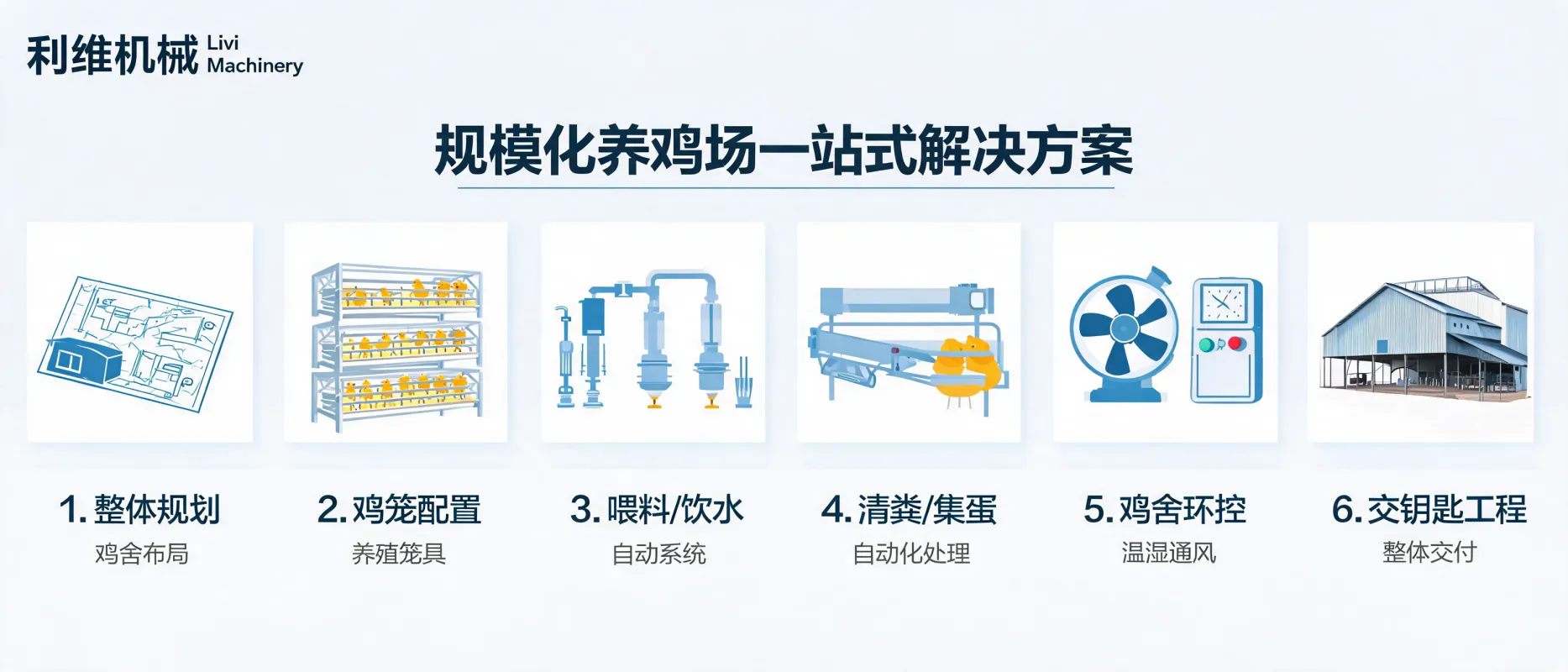
For investors and contractors, execution matters as much as equipment selection. Evaluate whether the supplier can contribute to the project from planning through handover—especially when aiming for an EPC-style turnkey poultry farm solution.
Delivery checklist questions
- Site input: what information do they require to start planning (land size, target capacity, climate, utilities)?
- Project outputs: what documents will you receive (layout, bill of materials, interface list, packing list)?
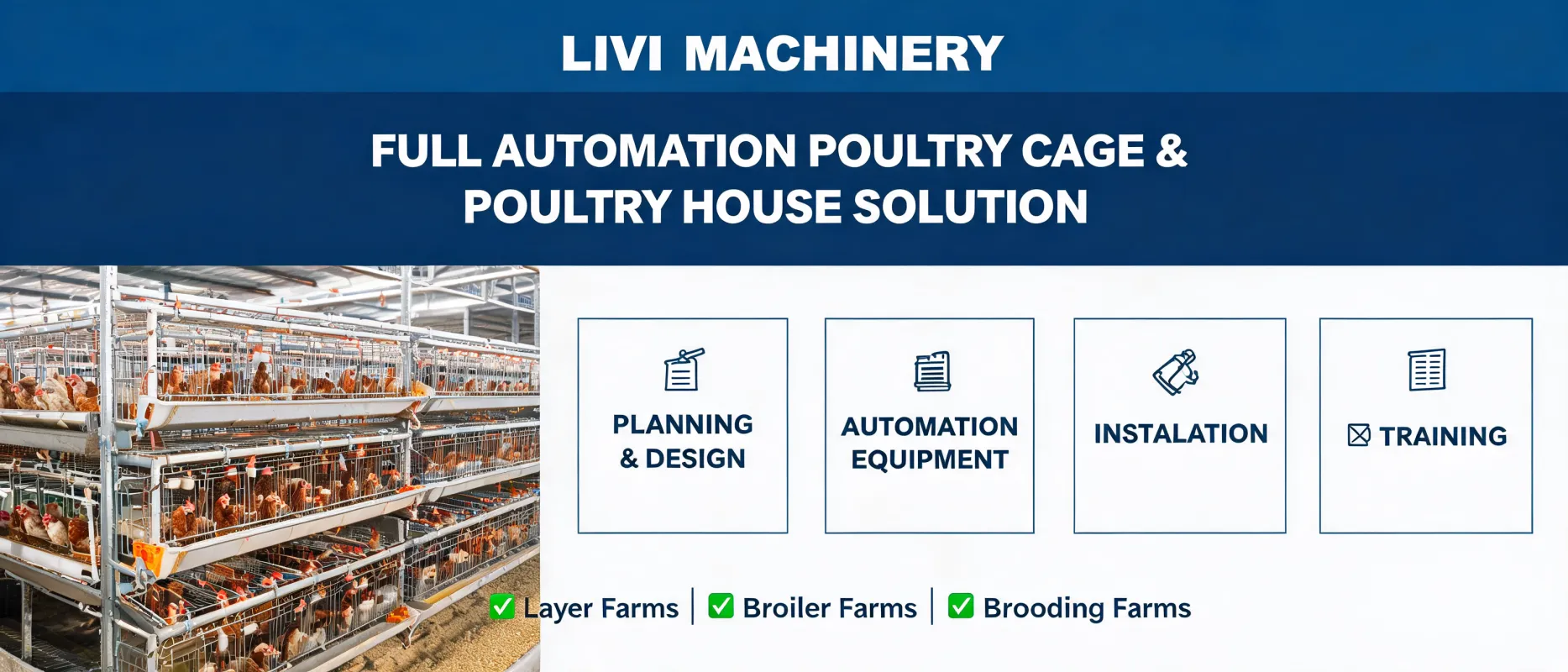
- Installation approach: do they provide installation guidance and commissioning support?
- Training: do they offer operation and routine maintenance training for farm staff?
- Spare parts: how are consumables and critical spares identified and supplied?
What Livi Machinery typically supports
Livi Machinery provides poultry farming equipment across the production process—such as layer cages, broiler cages, brooding & rearing cages, and supporting systems like automatic feeding, drinking, manure removal, egg collection, plus chicken house environment control and steel structure houses. The company also offers end-to-end project support from planning to delivery.
The goal is to help buyers coordinate a commercial farm build with fewer vendor interfaces—while keeping project scope and responsibilities clear.
4) Quality Inspection Workflow: How Do They Control Quality Before Shipment?
Ask for a transparent equipment quality inspection workflow. A reliable supplier should be able to explain checks from raw material selection to final dispatch—without vague statements.
- Incoming material control: criteria for key materials and components, and how nonconforming items are handled.
- In-process inspection: checkpoints during fabrication/assembly that reduce rework and hidden defects.
- Final inspection & packing: completeness check against the packing list and shipment readiness confirmation.
- Traceability: how batches, parts, and configurations are identified for after-sales support.
Livi Machinery emphasizes quality-first management, applying strict inspection from raw material screening through pre-shipment checks to improve delivery consistency.
5) Overseas Experience: Can They Execute Across Markets and Conditions?
Global delivery introduces challenges in logistics, local standards, climate differences, and on-site coordination. A supplier’s overseas execution record helps reduce uncertainty for commercial farms.
What to verify
- Markets served and typical delivery routes.
- Ability to support different power standards and site constraints.
- On-site support options (remote guidance vs. local partner support).
- Communication and documentation readiness for cross-border projects.
Livi Machinery in global projects (facts)
- Established in 2013, focused on R&D and manufacturing of poultry farming equipment.
- Served 1,000+ customers across 80+ countries and visited 1,000+ farms (as stated by the company).
- Key markets include Africa, the Middle East, Southeast Asia, South America, Central Asia, and Europe.
6) Fulfillment Models: Which Delivery Option Matches Your Timeline and Cost Structure?
Supplier capability is not only about manufacturing—it also includes how equipment reaches your site and how quickly you can secure spare parts. Confirm available fulfillment models and which one best fits your project.
| Fulfillment model | Best for | Questions to ask |
|---|---|---|
| Direct shipping | Standard international procurement with clear lead times | Packing method, shipment documents, loading plan, delivery schedule |
| Local production | Projects requiring local compliance or reduced freight | Which parts are localized, quality control consistency, supervision approach |
| Overseas warehouse | Faster access to common parts and selected equipment | Stock list, replenishment cycle, coverage area, lead time |
| Local distribution | Markets with established local channels and service partners | Warranty/service responsibilities, spare parts availability, escalation path |
Livi Machinery supports multiple fulfillment options including direct shipping, local production, overseas warehouse, and local distribution—allowing buyers to choose a model aligned with regional logistics and project timelines.
A Practical Buyer’s Scorecard (Use During RFQ & Supplier Comparison)
Supplier fit indicators
- Clear scope of supply with interface points identified
- Integrated product line for cages + supporting automation systems
- Project planning support aligned with your capacity target and site constraints
- Documented quality inspection before shipment
- International execution readiness (logistics, documentation, remote/on-site support)
Questions that prevent costly surprises
- What is included in your quotation, and what is explicitly excluded?
- Which parts are standard wear parts, and what spares do you recommend for the first year?
- How do you handle design changes after site measurement or civil works updates?
- What installation guidance and commissioning steps do you provide?
- Which fulfillment model do you recommend for my country and why?
Work With an Integrated Manufacturer for Clearer Accountability
For commercial poultry farm projects, an integrated manufacturer can simplify procurement, reduce vendor coordination, and improve project handover clarity. Livi Machinery positions itself as a system/overall solution provider serving global B2B markets—supporting projects from planning to delivery with poultry cage systems and supporting farm equipment.
If you share your project goals (bird type, capacity target, land size, and region), a supplier should be able to respond with a structured proposal: scope boundaries, layout direction, equipment list, and a realistic delivery approach.
Procurement-ready next step
To apply this checklist quickly, prepare: target capacity, bird type (layers/broilers/brooding), site dimensions, local climate, and preferred fulfillment model. This helps suppliers propose a compatible poultry equipment package and delivery plan with fewer revisions.


Hot Products

.jpg?x-oss-process=image/resize,m_fill,h_800,w_800/format,webp)


Popular articles



READY TO START?
Ready to Build Your Poultry Farm?
Tell us your land size, poultry type and farming capacity. LIVI will provide a complete farm solution for your project.