


Automated H-Type Layer Cage Systems for Large Poultry Farms: Installation Fit & Maintenance Essentials

Automation-Ready Poultry Equipment for Large Farms: A Practical H-Type Layer Cage Fit & Maintenance Playbook
For commercial layer operations above 50,000 birds, housing is no longer “infrastructure”—it becomes a productivity system. The H-type (multi-tier) automated layer cage has become a common choice for modern poultry farms because it compresses more capacity into the same footprint, supports cleaner manure handling, and stabilizes performance in challenging climates—especially in hot, humid regions across Africa where heat stress and ammonia build-up can quickly erase margins.
Decision-maker lens: The goal is not to “buy cages.” The goal is to reduce labor per 10,000 hens, maintain egg quality in peak heat, and keep the system running with predictable maintenance—season after season.
Why H-Type layer cages Win in 50K+ Bird Farms (When Designed for Automation)
In high-density commercial farms, every design decision should map to measurable outcomes: stocking efficiency, airflow stability, manure removal speed, and serviceability. A well-specified automated H-type cage system typically delivers:
| Performance Lever | What H-Type Enables | Reference Impact (Typical Range) |
|---|---|---|
| Space utilization | More birds per m² through vertical tiering and modular rows | ~1.4×–2.2× capacity vs. single-level layouts (site-dependent) |
| Manure automation | Belt-based manure removal reduces ammonia and manual cleaning | Often 60%–80% labor reduction in manure handling |
| Egg handling stability | Centralized collection lines reduce breakage risks | Egg breakage can drop by 0.3–1.0 percentage points with tuned conveyors |
| Climate management | Better airflow planning with consistent aisles and roof-to-floor ventilation paths | Lower heat stress risk when combined with fans/pads and correct row spacing |
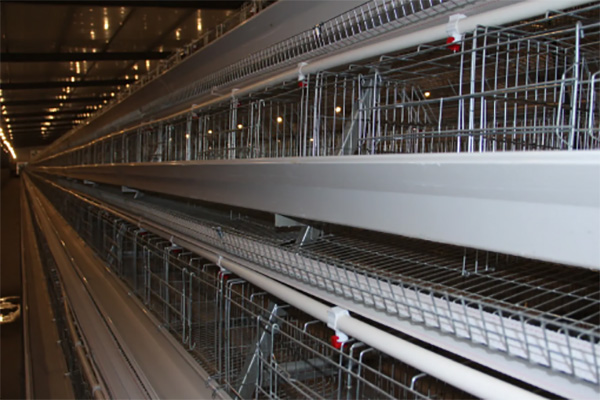
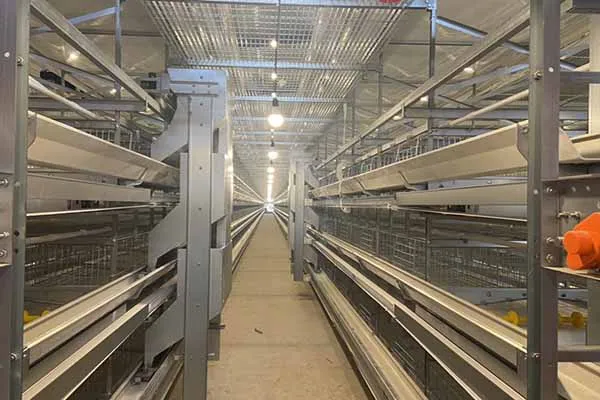
The key is system engineering. An H-type cage can be a powerhouse—or a bottleneck—depending on ventilation clearance, belt alignment, motor sizing, corrosion protection, and how well the farm’s building geometry matches the equipment specification.
Hot & Humid Africa: Design Checks That Protect Egg Output and Equipment Life
In many African regions, daytime temperatures can sit at 30–38°C for extended periods, with humidity frequently above 70% in coastal or rainy seasons. Under these conditions, farms usually face the same operational pain points: heat stress, wet manure, ammonia spikes, and corrosion.
1) Ventilation & heat dissipation are not “addons”—they are cage selection criteria
H-type systems work best when the layout preserves a clear airflow corridor. Buyers should check the cage row spacing, service aisle width, and whether the design supports airflow across tiers rather than creating stagnant heat pockets. As a practical target, many commercial houses maintain air speed around 1.5–2.5 m/s at bird level during peak heat, supported by correctly sized fans and inlet planning.
2) Manure belt specs matter more in humid climates
Wet manure increases belt load, raises motor stress, and accelerates odor/ammonia. A robust system uses stable belt materials, reliable tensioning, and a cleaning/scraper design that resists buildup. Many large farms schedule manure belt runs daily or every 1–2 days in humid seasons to keep ammonia under control and reduce fly pressure.
3) Corrosion protection needs to match local water and wash practices
If your farm uses frequent wash-downs or has high salinity water, confirm the protective finish for frames, fasteners, drinker lines, and brackets. In practice, better corrosion protection can extend key structural components to 15–20 years of service life under normal load, whereas under-specified coatings can show early deterioration much sooner in coastal humidity.
Installation Fit: A Field-Ready Checklist for H-Type Cage Projects
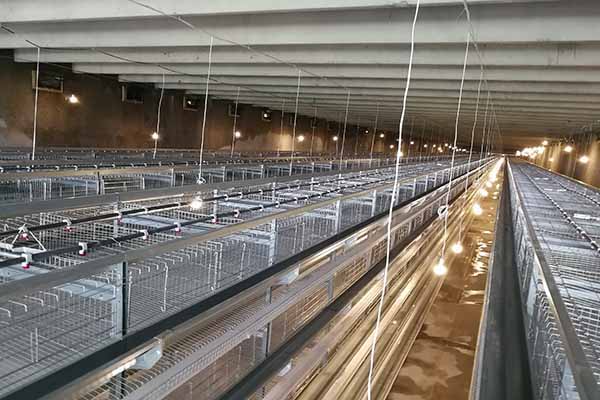
The most expensive poultry equipment failures are often not “manufacturing defects”—they are fitment errors: uneven floors, wrong row count, insufficient headroom, or misaligned conveyors that cause chronic downtime. A practical installation-fit process includes:
Pre-install survey (before shipment)
- House dimensions, columns, doors, and equipment room placement mapped to a row-by-row layout.
- Floor flatness verified; unevenness should be corrected to prevent long-term conveyor drift.
- Power capacity and backup plan validated for motors, fans, lighting, and controllers.
Core alignment steps (during install)
- Set reference lines for each row and tier; keep identical centerlines across the building.
- Check belt tension and roller alignment at multiple points, not just at endpoints.
- Dry-run egg and manure belts to confirm smooth start/stop and sensor response.
Commissioning (first 7–14 days)
- Monitor motor temperature and belt tracking under real manure load.
- Adjust drinker height/pressure to minimize leakage—especially critical in humidity.
- Create a weekly maintenance log from day one (downtime usually starts as “small noise”).
Operator tip: Treat belt tracking like tire alignment. Small deviations compound. A 15-minute weekly check can prevent a full-day shutdown later.
.jpg)
Maintenance That Actually Lowers Cost: What Large Farms Standardize
Large farms don’t “do maintenance when something breaks.” They standardize routines that keep the automation stable and predictable. For an H-type layer cage system, the highest ROI tasks usually sit in three areas: belts, drinkers, and drive components.
| Frequency | Task | What to Look For |
|---|---|---|
| Daily | Walk-through checks | Unusual noise, belt drift, wet spots under drinkers, egg collection smoothness |
| Weekly | Belt tracking & tension | Edge rubbing, roller debris, uneven manure load, scraper wear |
| Monthly | Drive units & sensors | Motor heat, chain/bearing condition, sensor positioning, controller alarm history |
| Per cycle | System audit | Corrosion points, fastener tightness, drinker line flush, spare parts replenishment |
In farms that adopt this routine, unplanned stoppages often drop noticeably over time, and maintenance becomes a predictable operating line rather than a crisis. As a practical benchmark, many high-performing commercial layer houses aim to keep automation downtime under 1–2% of operating hours during stable production periods.
What ISO 9001 & CE Really Signal for Large-Scale Poultry Equipment Buyers
Certification is not a decoration in a brochure. For large projects, it reduces risk in three practical ways:
- ISO 9001 commonly indicates controlled processes for sourcing, fabrication, and quality checks—helpful for consistency across repeated shipments and expansion phases.
- CE typically signals conformity to relevant safety and health requirements for machinery/electrical components—important for automation systems with motors, sensors, and control cabinets.
- Documentation discipline (manuals, wiring diagrams, maintenance schedules) becomes easier to standardize across multiple poultry houses, reducing training time.
For buyers, the most valuable question is simple: Can the supplier prove repeatability—the same performance, the same tolerances, the same support—when you expand from one house to three?
A Realistic Outcome Model: Where the ROI Usually Comes From
In large layer farms, the economics of automation often concentrate in a few repeatable gains: less labor per house, fewer egg losses, and fewer health setbacks tied to air quality. While results depend on management and climate control, commercial projects commonly report:
- Labor efficiency: automation can reduce routine handling roles, especially in manure removal and egg collection—often improving labor productivity by 30%–50%.
- Egg integrity: stable collection paths and fewer manual touches can reduce cracks, protecting grade-out rates.
- Environmental stability: frequent manure removal and cleaner aisles support lower ammonia peaks, which helps sustain appetite and production under heat pressure.
If a farm is operating in hot, humid conditions, the “hidden win” is often not just output—it is consistency. Consistency is what makes forecasting, contracts, and expansion possible.
Want a Proven H-Type Cage Installation Fit Plan for Your Farm Layout?
Get the practical details that help large farms avoid costly misalignment, ventilation bottlenecks, and belt downtime. Download our technical guide and request a layout review tailored to your bird capacity and local climate.
Download the H-Type Layer Cage Installation & Maintenance White PaperSuitable for 50,000+ layer projects, including hot & humid site considerations and commissioning checklists.
Quick Buying Signals: How Decision-Makers Compare Suppliers in One Page
When multiple quotes look similar, experienced buyers move beyond “steel thickness” and ask for proof of system discipline. The strongest suppliers can usually provide:
- Clear drawings and a row-by-row layout proposal aligned to your building constraints.
- Commissioning steps, spare parts list, and a maintenance rhythm matched to humid climates.
- Evidence of quality systems (e.g., ISO 9001) and safety compliance (e.g., CE) for automation components.
- Reference projects with similar bird counts and climate conditions, including real operational notes.
The farms that scale smoothly tend to choose equipment that is easy to service, predictable to operate, and engineered for the exact environment it will run in—not just the environment shown in a catalog.




Hot Products

.jpg?x-oss-process=image/resize,m_fill,h_800,w_800/format,webp)


Popular articles





READY TO START?
Ready to Build Your Poultry Farm?
Tell us your land size, poultry type and farming capacity. LIVI will provide a complete farm solution for your project.