


Common Procurement Pitfalls in Poultry Farming Equipment: Look Beyond Unit Price
Buying poultry farming equipment for a commercial layer, broiler, or pullet farm is not a “pick the lowest unit price” decision. A cage line, feeder, drinker, manure removal, and egg collection system must work together inside a poultry house that fits your climate, management style, and production target.
At Livi Machinery (Zhengzhou Livi Machinery Manufacturing Co., Ltd.), we manufacture poultry farming equipment and support customers with an end-to-end farm solution mindset—helping procurement teams evaluate system compatibility, total project cost, and lifecycle reliability rather than only comparing a single machine price.
Why “Unit Price Comparison” Often Fails in Poultry Equipment Procurement
A single quoted price (for example, per cage set or per feeding line) rarely includes the full engineering reality of a working poultry farm. In practice, project outcomes depend on how well all systems are matched and how the poultry house is planned, installed, and operated.
Procurement is a system decision
Feeding, drinking, manure removal, egg collection, and control components must align in layout, capacity, and interfaces—otherwise you pay later in downtime, rework, and operating inefficiency.
Hidden scope gaps appear after ordering
Many “cheap” offers exclude essentials like installation tools, commissioning, spare parts, wiring, poultry house requirements, or site adaptation—leading to change orders and delays.
Lifecycle costs outweigh initial price
Reliability, maintenance accessibility, parts availability, and energy/water/feed management will impact long-term operating cost and farm stability.
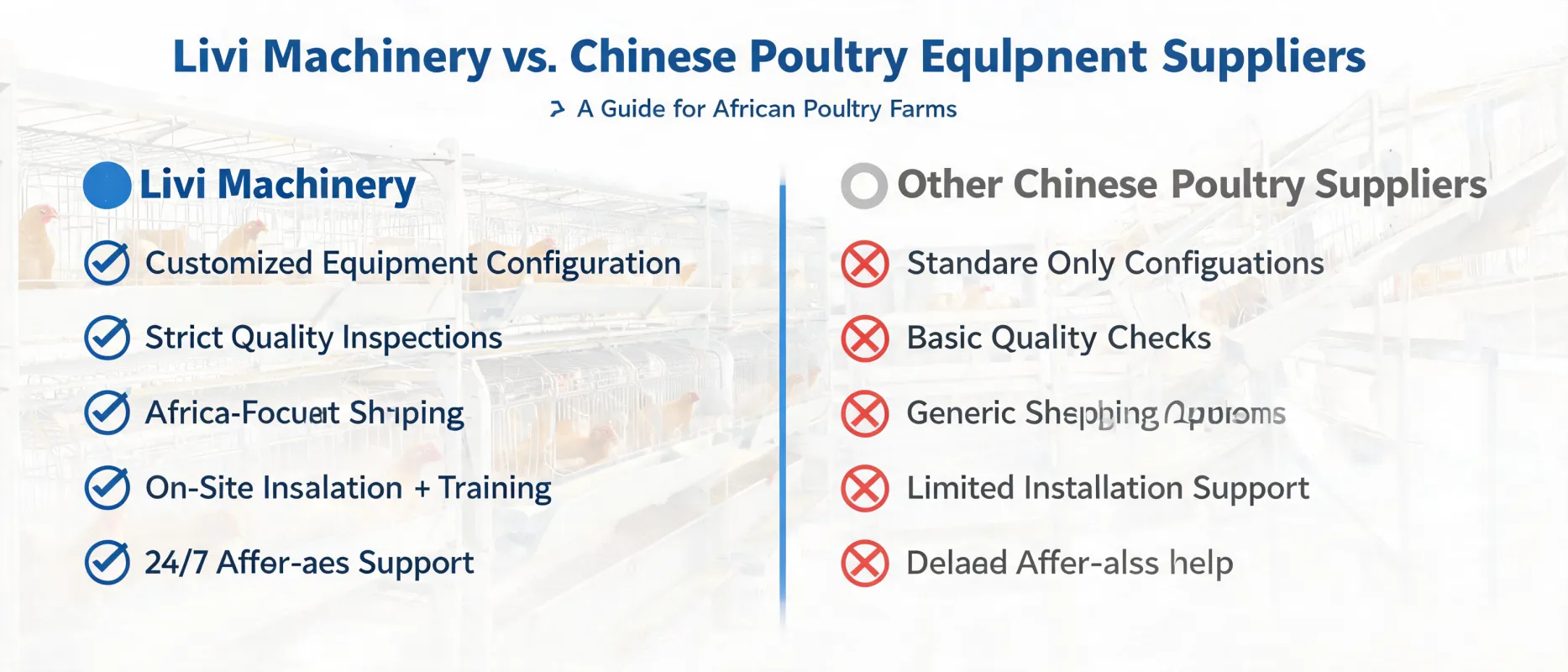
Common Procurement Pitfalls (and What to Check Instead)
A Practical Evaluation Framework: Focus on Total Project Cost
To compare suppliers fairly, use a structured assessment that covers engineering scope, delivery, and operating performance. The goal is to understand the total cost of the poultry farm project and the reliability of the full system.
How Livi Machinery Supports Smarter Procurement Decisions
One-stop solution perspective
We supply key poultry farming equipment modules—layer cages, broiler cages, pullet cages, automatic feeding and drinking systems, manure removal solutions, and egg collection systems—so specifications can be aligned as one complete system.
Project lifecycle support
From farm planning and site evaluation to customized design, manufacturing, installation, and technical support, we help customers move from land-ready to operation-ready with clearer scope control.
Manufacturing and quality control
Quality control is applied across the process—raw material selection, component inspection, assembly, and pre-shipment checks—aiming to deliver reliable equipment for scaled poultry operations.
Procurement success is not the lowest quote—it is the best-fit system with verifiable scope, reliable delivery, and sustainable operation for your farm conditions.
Before You Request Quotes: Prepare These Inputs
Clear inputs reduce re-quoting and help suppliers propose a compatible poultry farm solution. Consider preparing:
- Farm type: layers / broilers / pullets, target capacity, and expansion plan
- Poultry house dimensions, structural constraints, and local climate conditions
- Preferred automation level (feeding, drinking, manure removal, egg collection)
- Power/water availability and operation & maintenance capability
- Delivery model preferences (direct shipping, local production, overseas warehouse, local distribution)
Procurement note for commercial farms
When comparing offers, ask suppliers to present a complete scope list (equipment + accessories + installation/commissioning + spare parts plan) so you can evaluate total project cost and operational reliability on a like-for-like basis.


Hot Products

.jpg?x-oss-process=image/resize,m_fill,h_800,w_800/format,webp)


Popular articles

READY TO START?
Ready to Build Your Poultry Farm?
Tell us your land size, poultry type and farming capacity. LIVI will provide a complete farm solution for your project.