


Overseas Poultry Farm Construction: 5 Things to Confirm Before Purchasing Equipment
Building an overseas large-scale poultry farm is not only an equipment purchase—it is a project that must align house design, cage systems, feeding/drinking, manure handling, egg collection, ventilation, and climate control with local conditions. Many delays and cost overruns come from avoidable decision errors made before the first container ships.
This page highlights 5 things to confirm before purchasing equipment, so investors, contractors, integrators, and farm owners can compare suppliers with a clearer checklist and reduce project risk.
Mistake #1: Comparing only unit price instead of total project cost
A low “per-set” or “per-meter” price can be misleading if the quote excludes essential items or adds hidden costs later. For overseas procurement, the real decision should be based on total delivered and operable cost.
- Scope clarity: confirm whether the offer includes cages, frames, motors, controllers, sensors, spares, and connection parts.
- Compatibility cost: mismatched designs can force redesign of house layout, pits, air inlets, or electrical routing.
- Logistics & packaging: confirm packing method, container utilization, and protection for long-distance shipping.
- Commissioning readiness: equipment that arrives without drawings, labels, or manuals increases installation time and error rate.
A practical approach is to request a line-by-line quotation and compare suppliers on the same configuration and delivery terms—rather than on a single headline number.
Mistake #2: Overlooking poultry house–equipment matching
In overseas poultry farm construction, the poultry house is not a generic building. The house dimensions, column spacing, floor/pit design, drainage, and service corridors must be planned to match the chosen system—such as layer cages, broiler cages, brooding/growing cages and automated systems.
What to confirm with your supplier
- House length/width/height and the target stocking plan
- Row count, tier count, aisle width, and maintenance access
- Manure removal type and pit / belt layout requirements
- Feeding/drinking line routing and electrical load planning
- Egg collection route (for layers) and packing/handling space
Common mismatch outcomes
- Forced changes to building structure after equipment order
- Reduced capacity due to aisle or column conflicts
- Difficult maintenance because of tight access and unsafe layouts
- Poor hygiene flow (waste/egg/people traffic crossing)
Mistake #3: Lacking a complete ventilation & climate control plan
Ventilation and climate control are often under-specified, especially when buying equipment across borders. But performance depends on a cohesive plan that fits the local climate, the house design, and the stocking strategy. Without a complete design, farms may face heat stress, uneven airflow, high humidity, and management difficulties.
Good climate control is not a single device—it is a system design that must be confirmed at the same time as cage configuration and house layout.
Mistake #4: Not confirming installation, commissioning, and after-sales support
Overseas poultry projects often involve multi-party coordination (civil works, steel structure, electrical, farm management). If installation responsibilities are unclear, the project may face delays, rework, or incomplete commissioning.
Confirm support boundaries in writing
For large farms, also confirm how the supplier supports operator training and routine maintenance planning so the equipment can be used safely and consistently.
Mistake #5: Ignoring local climate and farming conditions
Equipment configuration should not be copied from another country without adaptation. Temperature, humidity, dust, power stability, water quality, and local management habits affect design decisions for ventilation and climate control, drinking systems, corrosion protection, and daily operation.
Local factors to provide to your supplier
- Project location, seasonal temperature range, and humidity profile
- Power supply stability, backup generator plan (if any)
- Water source type and basic quality considerations
- Feed supply and storage plan
- Biosecurity requirements and local regulatory constraints
Why it matters
A design that fits local conditions helps avoid frequent adjustments after installation and supports smoother daily management—especially for ventilation and climate control system performance.
A practical procurement checklist for overseas poultry farm projects
- Define farm capacity targets and production type (layers, broilers, brooding/growing) and confirm the matching equipment configuration.
- Request a complete bill of materials and compare quotations on the same scope and terms (not unit price alone).
- Confirm poultry house–equipment matching: layout, aisles, manure handling, egg collection (for layers), and utility routing.
- Review a complete ventilation & climate control plan that matches local climate and house structure.
- Confirm installation/commissioning responsibilities, documentation, training, spare parts, and after-sales process before payment milestones.
How Livi Machinery supports overseas poultry farm construction
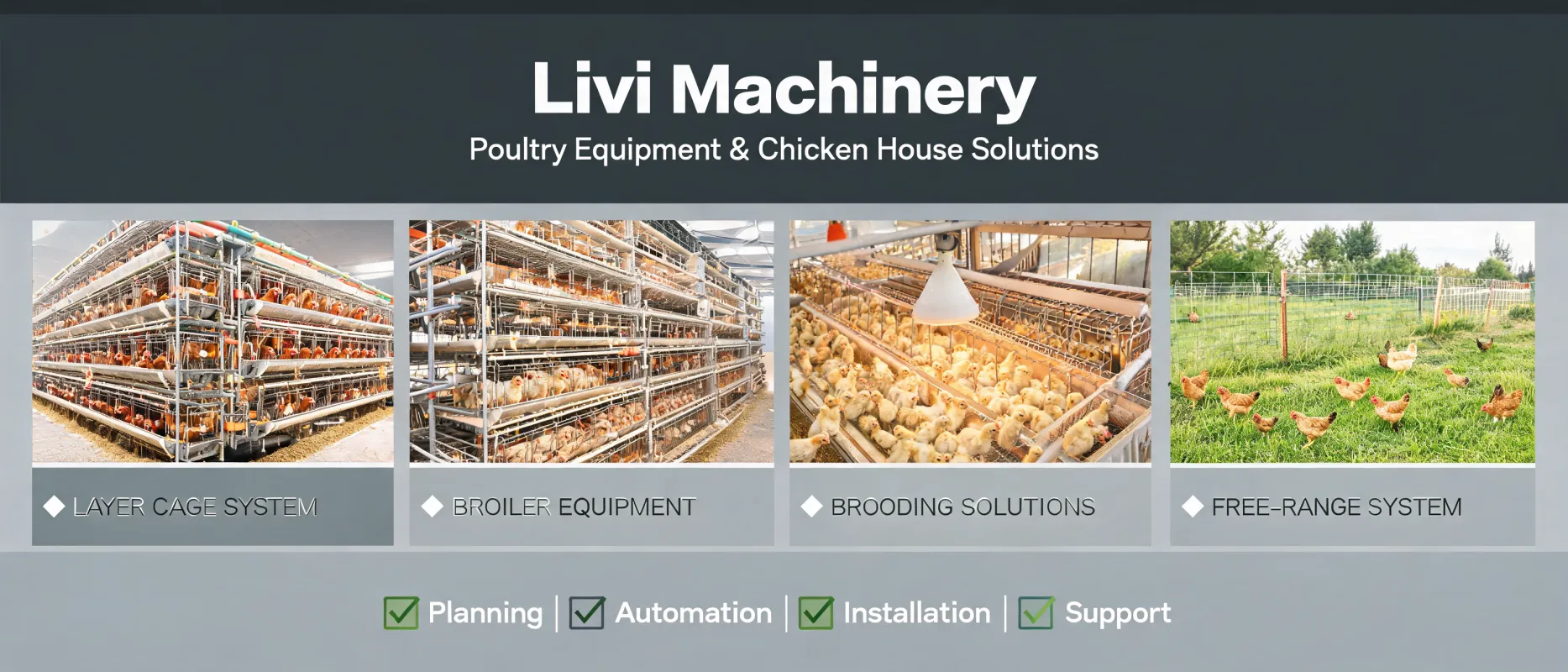
Livi Machinery (LIVI) is a poultry farming equipment manufacturer and integrated solution provider focused on large-scale farm delivery. Our product scope covers the full farming process, including poultry cages (layer cages, broiler cages, brooding & growing cages), automatic feeding, automatic drinking, automatic manure removal, automatic egg collection, and poultry house environmental control, along with supporting solutions such as steel structure poultry houses.
For overseas projects, we help align poultry house and equipment matching, clarify procurement scope, and support project delivery from planning to handover—so buyers can evaluate proposals with clearer technical boundaries and reduce avoidable rework.
Best fit for
- Farm investors planning new builds or expansion overseas
- EPC contractors / integrators preparing supplier comparisons
- Commercial farms requiring scalable, automated equipment systems
What to prepare when contacting us
- Project country/region and expected start timeline
- House dimensions (or land size) and target capacity
- Production type (layers/broilers) and automation expectations
- Known local climate and utility conditions (power/water)
With a clear checklist and matched design, overseas poultry farm construction becomes more predictable—from equipment procurement to stable operation.


Hot Products

.jpg?x-oss-process=image/resize,m_fill,h_800,w_800/format,webp)


Popular articles


READY TO START?
Ready to Build Your Poultry Farm?
Tell us your land size, poultry type and farming capacity. LIVI will provide a complete farm solution for your project.