


What Equipment Does a Modern Large-Scale Poultry Farm Need?
Modern commercial poultry farming depends on well-matched equipment systems that work as one workflow—from housing and bird space to feeding, drinking, manure handling, egg collection, and climate control. As an integrated manufacturer and solution provider, Livi Machinery supports global layer and broiler projects with durable equipment and EPC-style, one-stop delivery: planning, supply, installation guidance, and project handover.
This page explains the core equipment configuration for a modern large-scale poultry farm (layers & broilers), the role of each system in the production process, how systems integrate, and what to evaluate during planning: capacity, house layout, automation level, and local environmental conditions.
Core Equipment Systems in a Modern Poultry Farm
A large-scale farm is typically built as a set of interconnected systems. Choosing compatible specifications across systems is key to stable daily operation and easier management.
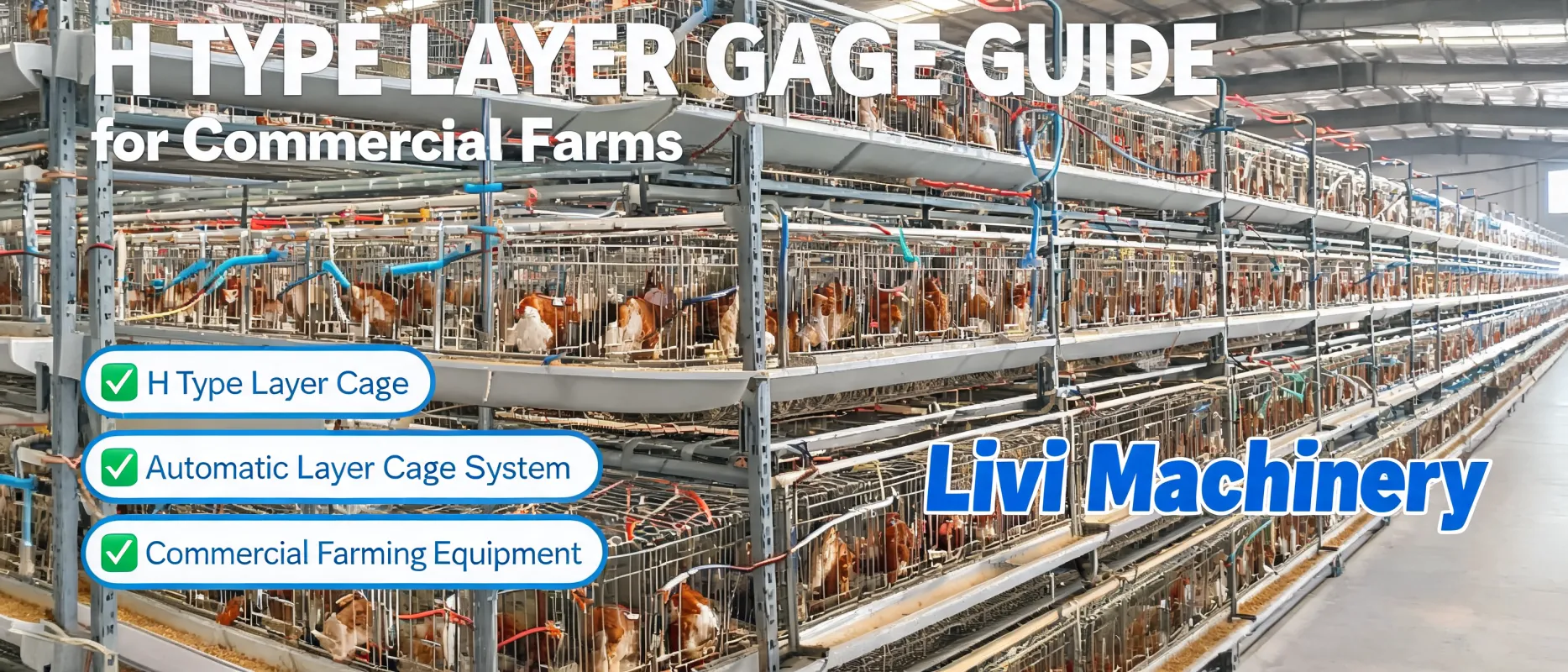
1) Poultry Cage System (Layers & Broilers)
The cage system defines bird capacity, stocking organization, daily labor intensity, and hygiene control. Livi Machinery provides solutions for:
- Layer cage systems designed for egg production workflow and smooth integration with egg collection.
- Broiler cage systems designed for efficient grow-out and farm sanitation management.
- Options to match different farm sizes, house dimensions, and desired automation levels.
Planning tip: align cage layout with feeder/drinker lines, manure removal lanes, and service aisles to avoid bottlenecks.
2) Automatic Feeding System
Feeding systems support consistent feed delivery and help standardize daily routines across houses. In a modern farm configuration, the feeding system should be selected based on:
- House length and line routing to ensure stable conveying and easy maintenance access.
- Target capacity and feeding frequency to match production rhythm.
- Integration requirements with cage rows and management practices.
3) Automatic Drinking System (Nipple Drinking)
A nipple drinking system helps provide clean, controlled water delivery and reduces wet litter/dirty areas around drink points. When configuring drinking lines, consider:
- Water quality and filtration needs based on local conditions.
- Line placement and height adjustment aligned to bird stage.
- Compatibility with cage structure and ease of sanitation.
4) Manure Removal System
Manure handling affects biosecurity, air quality, labor requirements, and overall house cleanliness. A modern configuration typically aims for:
- Regular removal to reduce ammonia and improve in-house environment.
- System selection that matches cage type, row count, and house geometry.
- Clear downstream plan for collection, transport, and site management.
5) Egg Collection System (Layer Farms)
In layer farms, egg collection equipment supports efficiency and consistent handling throughout the day. A well-configured egg collection system should:
- Integrate smoothly with the layer cage structure and aisle plan.
- Support stable collection flow for the farm’s target capacity.
- Help reduce unnecessary manual handling steps where automation is desired.
6) Poultry House Climate Control (Ventilation / Cooling / Heating)
Climate control is essential for bird comfort and stable production, especially in regions with high heat, humidity swings, or cold seasons. A complete house environment configuration typically covers:
- Ventilation design aligned to house size and stocking density.
- Cooling measures for hot climates and peak seasonal loads.
- Heating support where required for chick rearing or cold regions.
System sizing should be based on local environmental conditions (temperature range, humidity, wind), house structure, and intended stocking plan.
7) Steel Structure Poultry House & Farm Infrastructure
The poultry house is the foundation that supports equipment performance. For large-scale projects, steel structure poultry houses and supporting infrastructure help standardize build quality and installation accuracy. Key elements include:
- House dimensions and internal layout for cage rows, aisles, and equipment lines.
- Compatibility with ventilation and climate control planning.
- Project logistics and installation sequencing to reduce rework.
How These Systems Work Together (Workflow View)
A modern poultry farm is most efficient when each system is configured as part of one integrated workflow:
- Housing & layout determine cage rows, aisle widths, service access, and equipment line routes.
- Feeding and drinking deliver daily input consistently across all rows.
- Manure removal supports hygiene and air quality, helping climate control perform better.
- Egg collection (layers) links production output to handling and storage routines.
- Climate control stabilizes the house environment so birds can maintain normal growth and productivity.
Key Evaluation Points Before You Finalize the Equipment Configuration
| Evaluation item | What to clarify | Why it matters to the system selection |
|---|---|---|
| Target capacity | Bird numbers per house, number of houses, production type (layers/broilers) | Determines cage configuration, line quantity, and workload planning |
| House layout | House dimensions, aisle plan, equipment routing, service zones | Ensures feeding/drinking/manure/egg systems fit without interference |
| Automation level | Which processes to automate (feeding, manure, eggs, climate) | Impacts CAPEX, labor model, maintenance approach, and integration complexity |
| Local conditions | Climate, utilities stability, water quality, site constraints | Guides climate-control selection and infrastructure readiness |
| Delivery & service model | Direct shipment, local production, overseas warehouse, local distribution | Affects lead time, on-site coordination, and spare-parts planning |
Practical recommendation: confirm the “must-have” automation modules first, then match cage type and house structure accordingly, and finally optimize for local environment and operational habits.
Why Global Customers Choose Livi Machinery for Poultry Farm Projects
- End-to-end coverage across the poultry farming process: cages, feeding, drinking, manure removal, egg collection, climate control, and steel structure houses.
- Project-oriented thinking: equipment selection is aligned with capacity, layout, and automation goals—not treated as isolated items.
- Quality-first manufacturing: strict inspection control from raw materials to shipment as part of normal production discipline.
- International project experience: serving customers in more than 80 countries and regions with diverse climates and operating practices.
Talk to Us About Your Farm Plan
If you are planning a new commercial layer or broiler farm—or upgrading to higher automation—Livi Machinery can help you define a practical equipment configuration based on your target capacity, house layout, and local conditions.
Share your planned farm type (layers/broilers), land size, expected bird capacity, and climate/utility conditions. We will align the cage system and automatic equipment modules into one workable solution for your project.

郑州利维机械高效H型层蛋鸡笼系统

Hot Products

.jpg?x-oss-process=image/resize,m_fill,h_800,w_800/format,webp)


Popular articles

READY TO START?
Ready to Build Your Poultry Farm?
Tell us your land size, poultry type and farming capacity. LIVI will provide a complete farm solution for your project.