


How to Configure Equipment for a Large-Scale Poultry Farm: Planning and Automation System Selection
Configuring equipment for a large-scale poultry farm is not about buying the most automation—it’s about selecting coordinated systems that match your poultry house plan, target capacity, bird type (layers/broilers/pullets), labor model, and climate conditions.
As a specialized poultry equipment manufacturer since 2013, Livi Machinery (Zhengzhou Livi Machinery Manufacturing Co., Ltd.) supports project owners with a structured method to align cage systems, automatic feeding, drinking, manure removal, egg collection, and climate control—reducing mismatch, rework, and over-configuration risks.
1) Start with Planning: Define the Equipment “Boundary Conditions”
Before selecting any equipment model, clarify the inputs that determine compatibility and sizing. In large projects, most inefficiencies come from early assumptions not being translated into equipment interfaces (layout, capacity, installation space, electrical/water requirements, ventilation load).
- Production target: bird type (layers/broilers/pullets), target headcount, stocking density, growth stage and batch strategy.
- Poultry house constraints: house dimensions, number of rows/aisles, floor type, ceiling height, available utility corridors.
- Local climate profile: temperature/humidity range, wind, dust, seasonal variation (affects climate control and ventilation sizing).
- Labor and management: desired automation level, staffing plan, maintenance capability, biosecurity workflow.
- Utilities: power stability, water quality/pressure, drainage plan, backup strategy.
- Compliance and logistics: local animal welfare/regulatory requirements, shipping/installation conditions.
2) Choose the Core System First: Layer/Broiler Cage System Selection
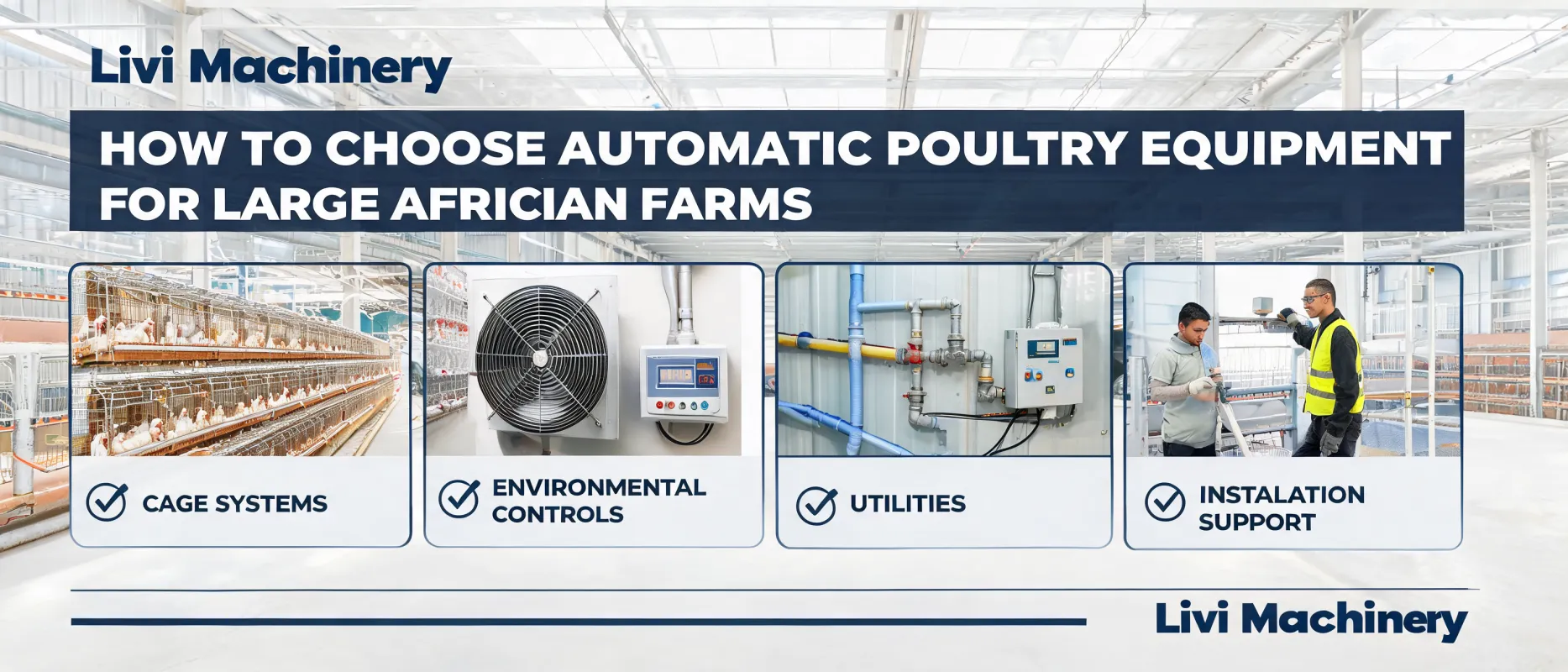
The cage system is the structural “backbone” of a large-scale poultry farm. It determines the house layout, automation interfaces, manure route, and working aisles. Selecting cages first makes the downstream selection of feeding, drinking, egg collection, and manure removal more consistent.
Layer cage system: what to confirm
- Tier/row configuration aligned with building width and ventilation route
- Egg handling concept: egg belt routing, collection points, cross conveyors
- Manure handling: belt type/width, drop points, discharge location
- Service aisles and maintenance access (daily inspection + belt service)
Broiler cage system: what to confirm
- Feeding/drinking reach and uniformity across tiers
- Manure removal frequency and route planning
- Harvesting/transfer workflow compatibility
- Ventilation distribution to avoid dead zones
Practical tip: In large-scale builds, the cage layout and belt routes should be checked together with fan/cooling pad placement and service corridors. This helps avoid later modifications that increase cost and delay commissioning.
3) Match the Automation Systems as a Coordinated Set
After the cage system is fixed, configure the automation modules as an integrated chain. Each module has sizing and interface points (capacity, route, control logic, and maintenance space). The goal is a stable, maintainable system—not maximum complexity.
Over-configuration risk to watch: adding automation modules without confirming interfaces (belt route, room space, utility capacity, control logic) can create bottlenecks. A simpler, well-matched configuration often performs more reliably at scale.
4) A Practical Configuration Workflow (Project Owners Can Follow)
- Set targets: bird type, scale, batch strategy, labor level, and performance priorities (e.g., ease of management, biosecurity, automation depth).
- Confirm poultry house plan: dimensions, aisle allocation, utility corridors, and equipment rooms (egg room, control room, manure discharge zone).
- Select cage system: layer cage system selection or broiler cage system selection based on house constraints and workflow.
- Match automation modules: automatic feeding and drinking system, manure removal, egg collection, then climate control equipment sized to the final layout.
- Review interfaces: mechanical routes (belts/augers), electrical loads, water lines, drainage, and maintenance access.
- Prepare delivery and installation plan: sequencing, local conditions, training and technical support requirements.
5) Where Livi Machinery Fits: From Layout to Integrated Supply
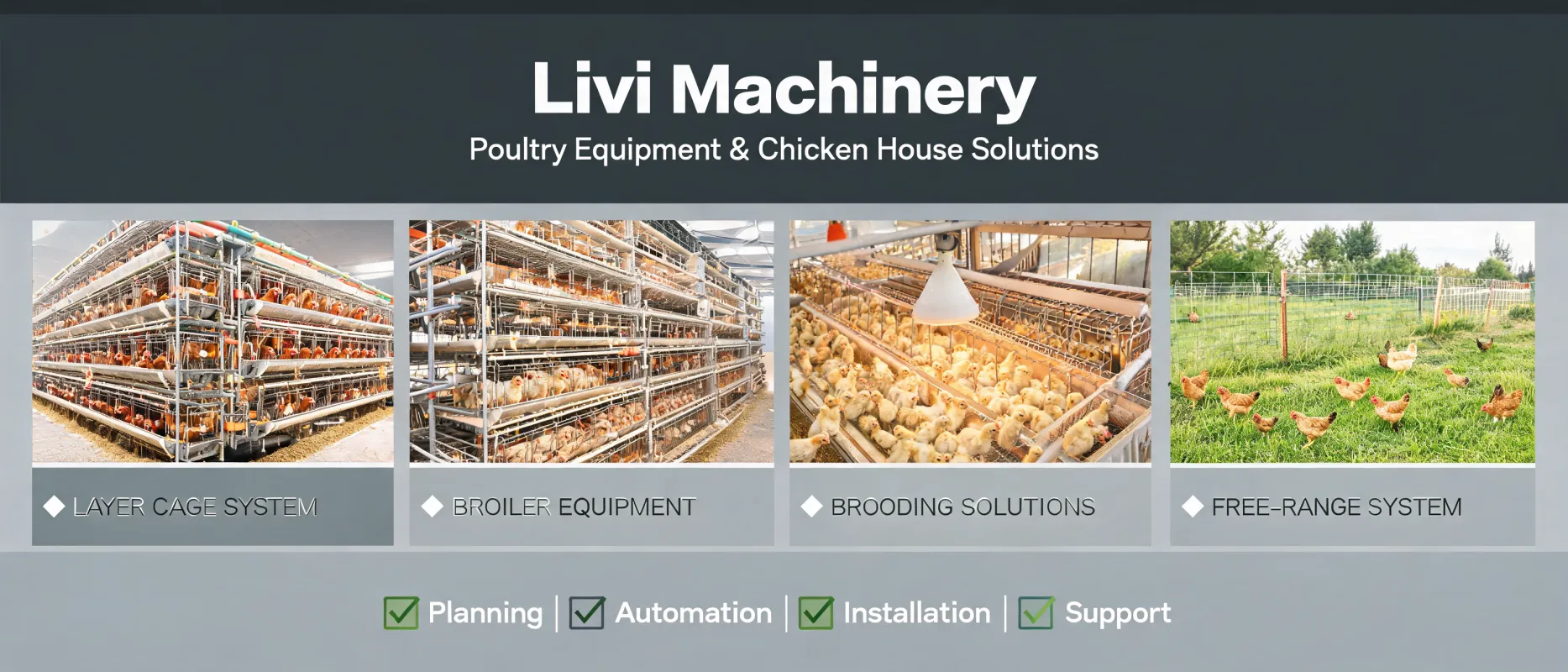
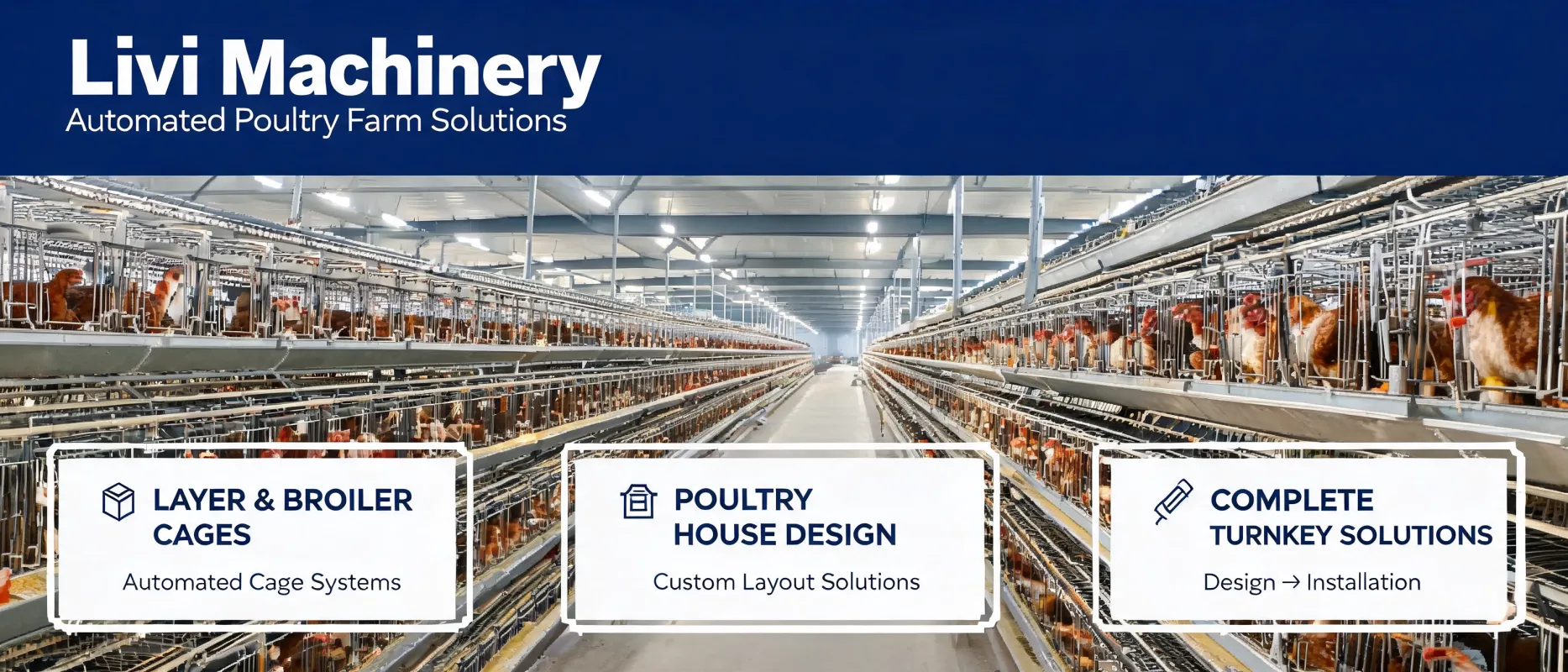
Livi Machinery focuses on the design, manufacturing, and supply of modern poultry farming equipment, including layer cages, broiler cages, pullet cages, and automation systems for feeding, drinking, egg collection, manure removal, and poultry house climate control. As an integrated manufacturer and solution provider, we support large-scale projects with a one-stop approach across the project lifecycle—from planning and customized design to production, installation support, and technical guidance.
What you can clarify with us
- House layout feasibility for your target capacity
- System matching logic to avoid incompatibility
- Customization for different climates and site conditions
- Installation and commissioning coordination
Service coverage (project practicality)
- Equipment manufacturing with process-based quality control
- On-site installation support via localized service capability in multiple countries
- Technical support aligned to real farm operation needs
- Applicable to varied temperature conditions based on project requirements
Talk to Livi Machinery About Your Farm Configuration
If you are planning a new build or upgrading an existing site, we can review your poultry house plan and help outline a large-scale poultry farm equipment configuration that fits your goals—covering cages and coordinated automation systems (feeding, drinking, manure removal, egg collection, and climate control).
Share your target bird type, capacity, location/climate, and any existing building dimensions to start a structured configuration discussion.


Hot Products

.jpg?x-oss-process=image/resize,m_fill,h_800,w_800/format,webp)


Popular articles

READY TO START?
Ready to Build Your Poultry Farm?
Tell us your land size, poultry type and farming capacity. LIVI will provide a complete farm solution for your project.