


H-Type Automatic Layer Chicken Cage Systems for Hot, Humid Africa: Selection Guide & Manure Cleaning Efficiency Comparison

Raising Layers in Hot & Humid Africa? Here’s How an H-Type Automatic Cage System Solves the 4 Problems Costing You Money
If your poultry house feels like a “heat box” by midday, if manure piles build up faster than your team can remove them, and if you’re still trying to scale with a layout designed for small flocks—your production is paying the price. In many high-temperature, high-humidity regions across Africa, layer farms often hit the same wall: low stocking density, weak ventilation, slow manure removal, and rising labor costs.
This guide breaks down how the Zhengzhou Livi Machinery H-Type Automatic Layer Chicken Cage System is selected and used in real-world hot/humid conditions—so you can choose equipment that delivers measurable returns, not just shiny specs.
A quick self-check
In the last 30 days, did you face any of these?
- Birds panting or reduced feed intake during hot hours
- Wet litter/manure smell stronger after rain or high humidity
- More flies, higher disease pressure, or uneven egg output
- Labor spending growing faster than egg revenue
If yes, you’re not alone—and your solution should be structural, not temporary.
Why “hot + humid” changes everything
In many African climates, daytime temperatures commonly reach 30–38°C, and relative humidity often stays at 70–90% in rainy seasons or coastal zones. Under these conditions, poor airflow and delayed manure removal can quickly raise ammonia, moisture, and pathogen load.
The goal is simple: make every square meter, every airflow path, and every labor hour produce visible ROI.
1) Space Utilization: Why H-Type Stacking Often Adds 30%+ Capacity Without Expanding Land
When land, building materials, and power supply are limited, the fastest way to scale is improving stocking density per floor area—but without compromising airflow and daily management. Traditional single-tier or basic A-type setups tend to waste vertical space and narrow your options for automation.
Reference capacity comparison (same house footprint)
These are practical reference ranges seen in commercial design planning; your final number depends on cage spec, aisle width, and ventilation design.
What makes the H-type approach attractive in Africa is not only “more birds.” It’s the fact that automation becomes easier and more consistent when your system is built to integrate feeding, drinking, egg collection, and manure removal in a repeatable flow.
2) Ventilation & Heat Relief: The Hidden Advantage of an H-Frame Airflow Path
In hot and humid weather, layers struggle to release body heat. If airflow is blocked or uneven, heat pockets form—especially in the middle tiers—leading to stress, lower egg rate, and higher mortality risk during extreme days.
A well-designed H-type stacked system supports cleaner aisle structure and more predictable air channels. When paired with correctly sized fans and inlets, this can improve air exchange consistency across tiers and reduce “dead zones” where heat and moisture build up.
.jpg)
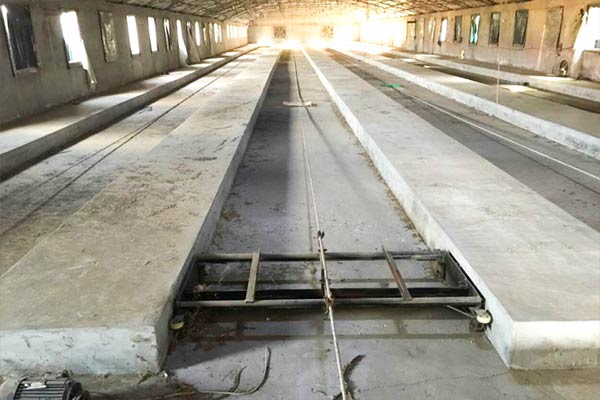
3) Manure Removal Efficiency: 60% Faster Cleaning Is Also a Disease-Control Strategy
In high humidity, manure turns wet and sticky faster. If your cleaning cycle falls behind, you’re not just fighting smell—you’re increasing flies, coccidia pressure, bacterial load, and ammonia peaks. That’s why manure handling should be treated as a biosecurity workflow, not a “when we have time” task.
Manual vs. automatic manure removal (reference comparison)
If your farm is scaling, the question becomes: do you want hygiene to depend on daily labor availability—or on a system that runs on schedule?
Many farms in hot/humid areas discover a simple truth: the fastest way to reduce stress (yours and the birds’) is to shorten the time manure stays inside the house.

4) Maintenance Cost & Service Life: Choosing for 15+ Years, Not Just Installation Day
In many African markets, equipment downtime is expensive—spare parts can take time, and technicians may not be on-site. That’s why your selection should favor systems designed for stable operation over 15+ years with clear standards and documented production control.
When a supplier holds quality and safety certifications such as ISO 9001 and CE, it usually signals tighter manufacturing control, better traceability, and safer electrical/mechanical compliance for automation components. It doesn’t replace good farm management—but it reduces the chance you’re buying uncertainty.
A rational ROI lens (simple, practical)
When you evaluate an H-type automatic layer cage system, try this mindset:
- Labor savings: if automation reduces manure-related labor by 30–50%, what does that mean per month?
- Egg stability: smoother temperature/air quality can protect output consistency during peak heat periods.
- Downtime risk: fewer breakdowns often beats “cheaper” equipment that stops at the worst time.
You’re not buying steel. You’re buying a production rhythm.
A Practical 3-Step Selection Method (So You Don’t Overbuy—or Underbuild)
Step 1: Start with your target flock
Define your 12–18 month goal (e.g., 10k, 30k, 50k layers). H-type stacking is most economical when you plan beyond “just adding a few cages” and design airflow + automation pathways from day one.
Step 2: Match equipment to climate reality
If your humidity stays high for weeks, prioritize a manure belt system with a reliable routine schedule and a ventilation plan that reaches all tiers evenly. In hot seasons, “average airflow” is not enough—your weakest zone decides your results.
Step 3: Confirm standardization & serviceability
Ask for documentation (ISO/CE), parts list clarity, maintenance schedule, and remote support process. A strong system is one your team can keep running—even when supply chains slow down.
Your Turn: Are These the Same Problems You’re Facing?
You might be managing a farm that already has demand—but the facility layout and manure workflow are limiting your growth. Or you might be planning a new house and want to avoid expensive redesigns later.
Have you experienced poor airflow in the middle tiers, slow manure removal during rainy weeks, or labor costs rising faster than your flock? Leave a comment and tell us what your biggest bottleneck is.
Make Every Investment Show Its Return
Get the H-Type Automatic Layer Chicken Cage System technical white paper, including configuration options, ventilation/manure workflow recommendations, and a selection checklist tailored for hot & humid regions.
Prefer a direct answer? You can also request a 1-on-1 expert evaluation for your house size, climate zone, and target capacity.




Hot Products

.jpg?x-oss-process=image/resize,m_fill,h_800,w_800/format,webp)


Popular articles



READY TO START?
Ready to Build Your Poultry Farm?
Tell us your land size, poultry type and farming capacity. LIVI will provide a complete farm solution for your project.