


Global Trends in Large-Scale Poultry Farming: Automation, Intensive Production, and Smart Environment Control
Large-scale poultry farming is moving toward automation, intensive production systems, and smart environment control—not as buzzwords, but as practical responses to labor constraints, biosecurity expectations, and the need for stable management in commercial operations.
As an integrated manufacturer and solution provider, Livi Machinery (Zhengzhou LIVI Machinery Manufacturing Co., Ltd.) supports layer and broiler projects with cage systems, automated feeding/drinking, manure removal, egg collection, and poultry house climate control—helping farms scale with clearer workflows and more consistent daily execution.
- Systemized daily routines (feed, water, manure, eggs)
- Cage-based intensive layouts for capacity and management
- Climate control aligned with local weather and house design
- Configuration priorities that fit market realities and budgets
Trend 1: Poultry Farm Automation Becomes the Default Operating Model
In many commercial farms, the biggest operational risk is not “lack of equipment,” but inconsistent execution. Automation reduces variation by standardizing routine tasks and making performance easier to monitor and manage. The most adopted automation modules are typically:
Automated feeding
Designed to deliver consistent rationing along the line and simplify day-to-day workload. In intensive houses, a stable feeding rhythm supports smoother management and helps reduce human error.
Automated drinking
Water delivery systems are selected to match house layout and bird density. Practical goals include stable supply, easier inspection, and cleaner routine management—especially important for large flocks.
Manure removal
Automated manure removal is often prioritized for hygiene and house working conditions. A cleaner baseline helps daily operations stay predictable and supports biosecurity routines.
Egg collection
Automated egg collection aims to streamline collection routes and reduce handling steps in high-capacity layer houses. This supports orderly packaging processes and clearer workflow control.
In practice, farms often start automation with “highest labor load + highest hygiene impact” modules, then expand as the team stabilizes operations.
Trend 2: Intensive Cage Farming for Capacity, Consistency, and Manageability
Intensive cage-based production remains a mainstream direction for commercial projects because it structures space usage, creates repeatable workflows, and supports systematic automation. For layer farms, high-capacity cage layouts can align well with standardized feeding, watering, manure handling, and egg collection routines.
Related solution: Efficient H-Type Layer Chicken Cage (Livi Machinery)
Livi Machinery provides an Efficient H-Type Layer Chicken Cage designed for commercial layer operations. The system is described for farms ranging from 5,000 to 30,000 birds, supporting different scaling needs while keeping daily management structured.
- Material: Q235 steel
- Surface treatment: hot-dip galvanizing and Al-Zn alloy coating
- Durability reference: stated service life 15–20 years (depending on operating conditions)
- Structure: H-type layout designed to improve space utilization and routine access for feeding, cleaning, and egg handling
- Automation compatibility: can be configured with automated egg collection and manure cleaning systems
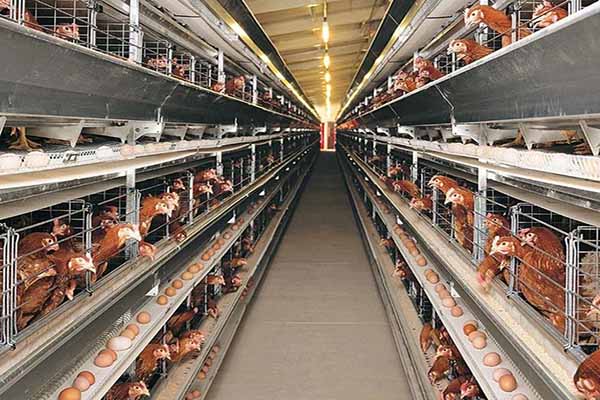
The product is described as following ISO 9001, ISO 14001, and CE related requirements, with quality control from raw materials to shipment.
Trend 3: Smart Climate Control System for Poultry Houses
As farms scale, environment control becomes a management system rather than a “single device.” Practical climate control focuses on maintaining stable operating conditions for the flock and enabling staff to follow consistent routines. Typical planning considerations include ventilation, temperature management, and how sensors/controls fit the poultry house design.
Why climate control is tied to automation
- High stocking density requires predictable airflow and heat management
- Stable house conditions support more consistent production management
- Clear setpoints and routines reduce dependence on individual operator experience
Configuration should match house + local climate
A smart climate control system for a poultry house should be selected together with the building plan (air inlets, fan arrangement, insulation approach, and operational targets). This is especially relevant when deploying standardized designs across different regions.
Market-Fit Priorities for Commercial Projects
For many large-scale poultry farming investors, the right configuration is determined by labor cost/availability, climate, infrastructure stability, and target production model. Below is a practical, non-prescriptive reference for common priorities across key markets mentioned in global projects.
| Region / market | Typical configuration focus | Implementation notes |
|---|---|---|
| Africa | Automation to stabilize labor efficiency; hygiene-oriented manure removal | Prioritize robust design and maintainable systems; plan for scalable expansion by house/unit. |
| Middle East | Smart climate control and ventilation planning | Heat management is often a primary design constraint; align equipment with house insulation and airflow pathways. |
| Southeast Asia | Ventilation + manure/hygiene routines; steady feeding/drinking systems | Focus on operational discipline and cleaning logistics; select configurations that fit high humidity environments. |
| South America | Capacity-oriented intensive systems; process efficiency for egg handling | Clarify production targets and workflow design early (collection routes, storage, packaging interface). |
| Central Asia | House design + temperature management; durable cage and coating choices | Plan for seasonal temperature variation; ensure materials and coatings match long-term operation needs. |
Note: final configuration should be determined by farm scale, local regulations, site conditions, and the chosen production model.
How Livi Machinery Supports Scalable Poultry Farm Operations
Livi Machinery has focused on poultry farming equipment manufacturing since 2013, covering the full process for modern poultry operations—layer cages, broiler cages, brooding/rearing cages, feeding and drinking lines, manure removal, egg collection, poultry house environment control, and steel-structure poultry houses. For commercial projects, the value of a single integrated supplier is the ability to align interfaces between systems.
When to consider an H-type high-capacity layer cage system
- You plan a commercial layer house where standardized routines are critical
- You want to integrate egg collection and manure cleaning to reduce manual steps
- You need a configuration path that can scale from mid-size to larger capacity (e.g., 5,000–30,000 birds)
- You prefer durable materials and corrosion-protection processes suited for long-term operation
Discuss Your Farm Scale, Market, and Configuration Priorities
If you are planning a large-scale layer project in Africa, the Middle East, Southeast Asia, South America, or Central Asia, Livi Machinery can help you map equipment choices to your local climate, workflow requirements, and capacity goals—covering intensive cage systems, poultry farm automation, and poultry house climate control as an integrated plan.
- Target bird capacity (layers / broilers)
- House type and available land footprint
- Preferred automation level (basic / mid / high)
- Local climate and power/water conditions
Efficient H-Type Layer Chicken Cage, automated feeding, automated drinking, manure removal, egg collection, poultry house environment control, and steel-structure poultry house solutions.

Hot Products

.jpg?x-oss-process=image/resize,m_fill,h_800,w_800/format,webp)


Popular articles

READY TO START?
Ready to Build Your Poultry Farm?
Tell us your land size, poultry type and farming capacity. LIVI will provide a complete farm solution for your project.