


Global Trends in Large-Scale Commercial Chicken Farms: Automation, Intensification, and Smart Climate Control
Modern large-scale commercial chicken farms are evolving quickly as producers respond to labor shortages, higher biosecurity expectations, and the need for more stable flock performance. Across global markets, three directions stand out: automation, intensification, and smart poultry house climate control.
Drawing on practical equipment experience and turnkey project delivery, Livi Machinery shares a structured view of these trends—especially for investors and farm owners planning new builds or upgrading existing poultry houses in Africa, the Middle East, Southeast Asia, South America, Central Asia, and Europe.
What “Large-Scale” Means Today: Standardization First
The global move toward larger farms is not just about adding more birds—it is about building repeatable management. Standardization is enabled by housing layout, equipment selection, and data-informed routines that reduce dependence on individual worker experience.
- More consistent daily operations (feeding, drinking, manure handling, egg collection)
- Better control of environmental variables through smart climate control
- Improved scalability for multi-house or multi-site expansion plans
Trend 1: Automation Systems Become the “New Baseline”
In many commercial operations, automation is no longer a premium add-on. It is increasingly treated as core infrastructure that supports stable output and predictable labor planning. The most common automation modules in modern poultry houses include:
Automatic feeding
Supports consistent feed distribution and helps reduce daily labor intensity; system design should align with house length, stocking density, and feeding strategy.
Automatic drinking
Aims for stable water availability and easier routine checks; water line layout and filtration practices are key to reliable operation.
Automatic manure removal
Improves daily hygiene management and supports better working conditions; performance depends on schedule planning and house ventilation design.
Automatic egg collection
Reduces manual handling and supports more standardized collection routines; correct alignment and gentle handling are essential to minimize losses.
Implementation note: Automation works best when the farm’s layout, power/water availability, staffing plan, and biosecurity flow are designed together—especially in new farm construction or full-house upgrades.
Trend 2: Intensification With Better Control (Not Just Higher Density)
Intensification is often misunderstood as simply increasing stocking density. In practice, global commercial farms focus on controlled intensification—expanding capacity while maintaining management visibility and operational stability.
- Process-driven operations: fixed routines for feeding cycles, water checks, manure schedule, and egg collection workflow
- Equipment matching: selecting poultry cages and automation modules that suit breed type, production stage, and local management habits
- Maintainability: planning for spare parts, cleaning access, and technician-friendly layouts to reduce downtime risk
Trend 3: Smart Poultry House Climate Control as a Production Stabilizer
As farms scale up, poultry house climate control becomes central to stable performance. Temperature, airflow, humidity, and air quality influence bird comfort and operational predictability, especially in regions with hot seasons, high humidity, or large day–night temperature swings.
Monitoring & control
Controllers and sensors help keep settings consistent and reduce reliance on manual adjustments.
Ventilation strategy
Ventilation design should match house structure and stocking plan, supporting air exchange and comfort.
Integration with operations
Climate control works best when coordinated with manure schedule, watering, and general hygiene routines.
For many large-scale farms, the goal is not “maximum automation,” but stable, repeatable environmental control aligned with the chosen production model and local conditions.
Market Considerations Across Key Regions
Although the direction is global, implementation priorities vary by region. When planning a modern commercial chicken farm, investors often evaluate automation and climate solutions through the lens of local supply chains, labor structure, and operating environment.
Africa & Middle East
Automation helps reduce labor dependence; climate control planning is often a key decision factor in hot seasons or arid conditions.
Southeast Asia
Humidity and weather variability increase the need for stable ventilation and management standardization.
South America & Central Asia
Scale-up plans often emphasize durable equipment, maintainability, and matching systems to local farm operations and logistics.
Europe
Projects frequently focus on standardized systems, reliability, and compliance-oriented planning across the full farm workflow.
How Livi Machinery Supports Modern Poultry Farm Planning
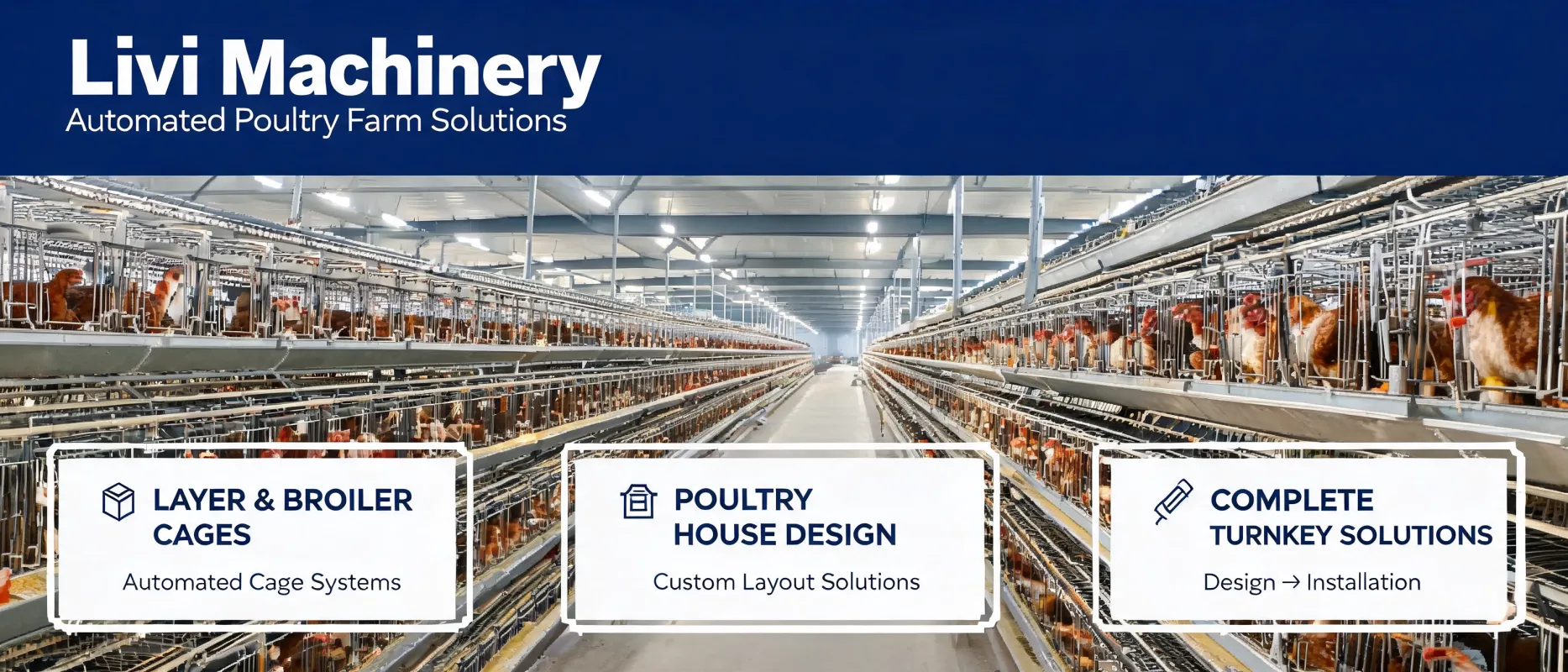
Livi Machinery is an integrated manufacturer and solution provider specializing in poultry farming equipment. Our scope covers poultry cages and key automation modules—feeding, drinking, manure removal, egg collection—plus poultry house climate control equipment and steel-structure house support for commercial-scale projects.
Turnkey mindset (EPC reference)
From planning to delivery, aligning equipment selection with farm workflow and long-term operation.
Quality-first execution
Strict inspection from raw materials to shipment to support durable, export-oriented supply.
Global delivery options
Direct shipment, localized production, overseas warehouses, and local distribution depending on project needs.
If you are comparing large-scale poultry farming system configurations, we can provide planning references that connect housing design, automation systems, and climate control into a practical execution path.
A Practical Checklist for New Builds & Upgrades
- Define the farm type and workflow (layers, broilers, brooding/growing) before choosing equipment modules.
- Plan automation systems as a connected set: feeding, drinking, manure removal, and egg collection should match the house layout.
- Treat poultry house climate control as a core stabilizer—coordinate ventilation and monitoring with daily management routines.
- Confirm local constraints early (power, water quality, spare parts access, and service capability).
- Choose an execution partner who can support design-to-delivery coordination and long-term maintainability.
Livi Machinery supports commercial chicken farm projects with integrated equipment and planning references—helping you move from concept to a workable, scalable poultry farm solution.


Hot Products

.jpg?x-oss-process=image/resize,m_fill,h_800,w_800/format,webp)


Popular articles

READY TO START?
Ready to Build Your Poultry Farm?
Tell us your land size, poultry type and farming capacity. LIVI will provide a complete farm solution for your project.