


Ghana 80,000 Layers Farm Case: Automation and Poultry House Design for Hot & Humid Conditions

Project context and goal
This page presents a Ghana 80,000-layer farm case designed for hot & humid conditions. The goal is to translate climate constraints into a practical poultry-house layout and an automation plan that can be installed, commissioned, and operated with stable daily routines.
The solution is delivered by Livi Machinery (Zhengzhou Livi Machinery Manufacturing Co., Ltd.) as an integrated automated layer cage equipment and poultry house overall solution—covering planning, equipment configuration, delivery coordination, installation guidance, training, and commissioning support.
What “hot & humid” changes in poultry house design
In hot and humid regions, the poultry house must be designed to manage heat load, moisture, and air quality at the same time. For a large layer project, these factors directly influence ventilation sizing, pad cooling strategy, manure handling frequency, and the material choices that help reduce corrosion risk.
- Ventilation priority: airflow routing and fan placement should support consistent air exchange across cage rows.
- Cooling pads integration: pad-and-fan coordination needs to match the building length and target airflow path.
- Moisture & ammonia control: manure removal strategy and housekeeping design affect humidity build-up and odor pressure.
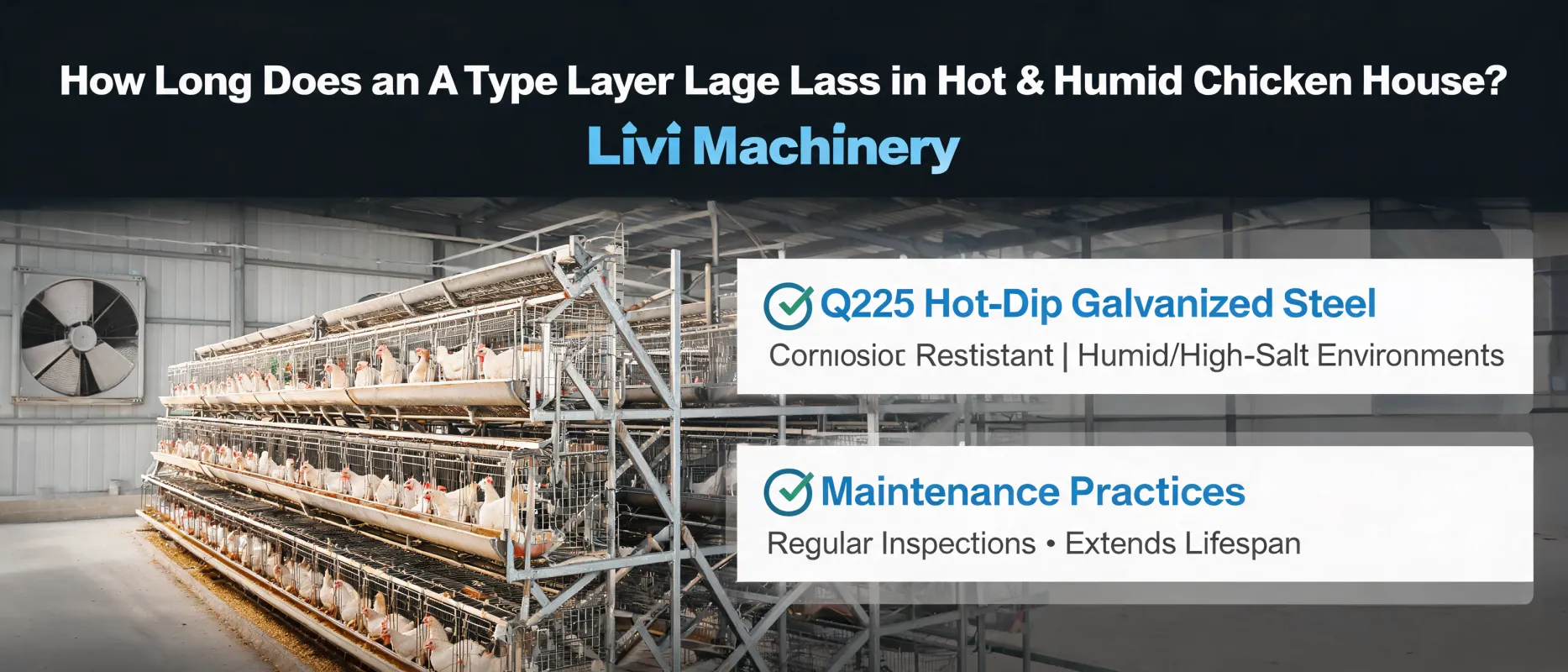
- Corrosion-resistance: humid air and manure gases accelerate corrosion; equipment selection should consider protective coatings and appropriate materials for long-term stability.
Solution scope by Livi Machinery (integrated equipment + overall poultry house solution)
For this Ghana layer farm case, Livi Machinery provides an integrated solution that links farm layout, layer cage system selection, and automation subsystems into one deliverable plan. This approach helps avoid typical issues such as mismatched building dimensions and equipment specifications, unclear maintenance access, or “standalone” automation that does not work as a workflow.
1) House planning & layout
Define cage row arrangement, service aisles, airflow path (inlet-to-exhaust), and locations for cooling pads and fans to fit hot & humid operation needs.
2) Equipment configuration
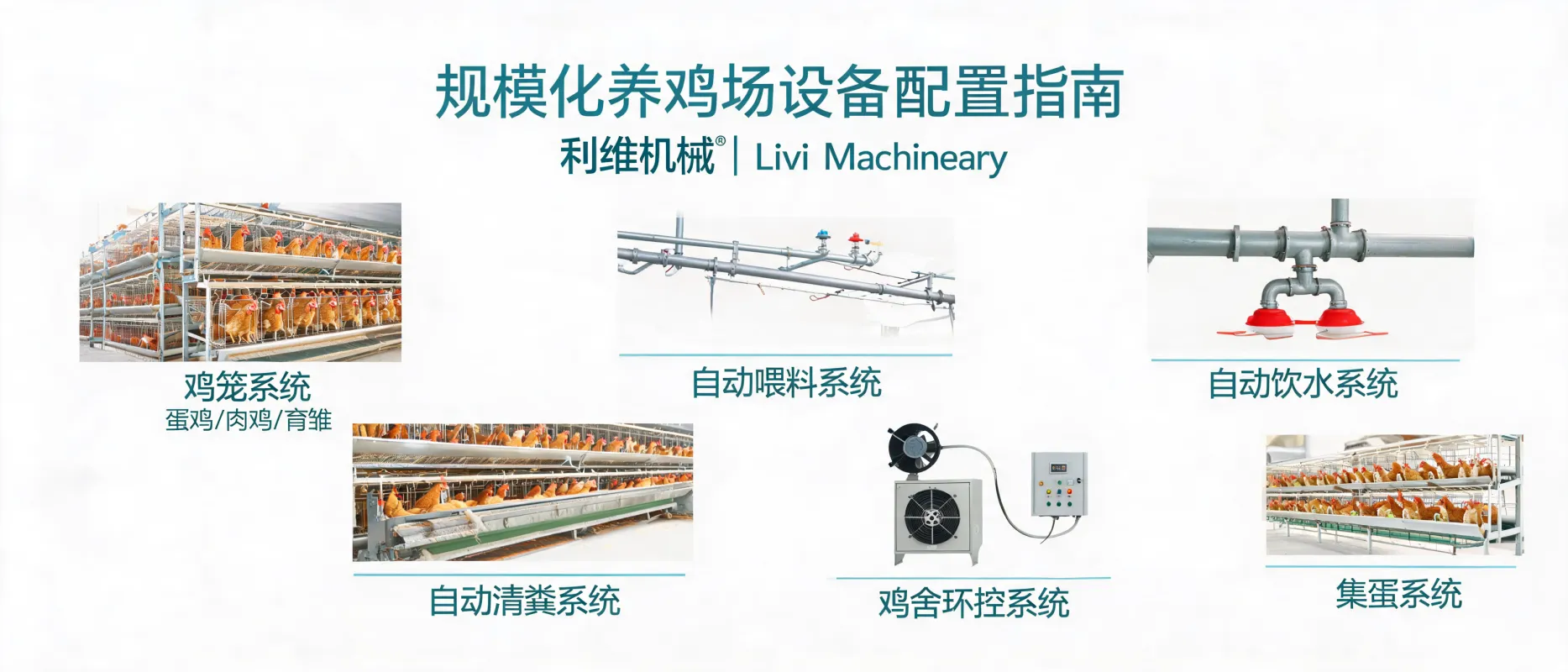
Select and match the layer cage type (A-type or H-type) and automation modules such as automatic drinking and manure removal as a coordinated system.
3) Delivery to commissioning support
From production and packing to installation guidance, on-site training, and commissioning assistance, supporting a smoother ramp-up to stable daily operation.
Key design topics in this Ghana case
Ventilation layout
Ventilation is treated as the “backbone” of hot & humid poultry house performance. The layout focuses on consistent airflow distribution, practical maintenance access, and stable operation during high-heat periods.
Cooling pads
Cooling pads are integrated with the ventilation plan so that incoming air passes through pads and moves efficiently across the cage area—supporting temperature relief without relying on manual intervention.
Automatic drinking system
Automatic drinking is configured as a hygiene and stability measure in humid climates—supporting consistent water access while reducing wet litter risks and unnecessary moisture inside the house.
Manure management strategy
Manure removal is planned as an operational routine that supports air quality. In hot & humid conditions, stable manure handling helps reduce ammonia pressure and improves daily working conditions.
Corrosion-resistance considerations
Equipment choices consider the combined effect of humidity and manure gases. Appropriate anti-corrosion treatment and material selection help maintain stable operation and reduce maintenance frequency.
In this case, “automation” is treated as a workflow design: ventilation + cooling + drinking + manure handling are configured to operate together under hot & humid constraints.
A-type vs H-type layer cages: how to decide for this project
For an 80,000-layer project, both A-type and H-type layer cage systems can be feasible. The selection should match local climate, available land, power conditions, automation target, and the confirmed house parameters.
| Decision factor | A-type layer cage (typical strengths) | H-type layer cage (typical strengths) |
|---|---|---|
| Land utilization | Clear structure; can fit step-by-step scaling plans. | Better vertical utilization for large-scale capacity within limited footprint. |
| Labor needs | Often suits operations that want a balanced automation pace. | Supports centralized management; commonly aligned with higher automation. |
| Automation scalability | Can be configured with key modules; scalable by project stage. | Designed for integrated automation (e.g., manure, egg collection) in large houses. |
| Maintenance convenience | Straightforward inspection and daily observation workflow. | Efficient for standardized procedures; requires good access planning and trained routines. |
Selection insight: Final procurement should be based on confirmed project parameters (house dimensions, target automation level, local power reliability, climate requirements, and budget). Livi Machinery supports parameter-based configuration rather than one-size-fits-all recommendations.
Project delivery milestones (from layout to commissioning)
To make the automation system and poultry house design executable, the delivery is organized into clear milestones. This helps align design decisions with installation realities and commissioning needs in Ghana.
- Requirement confirmation: capacity target (80,000 layers), climate constraints, land and power conditions, and operational expectations.
- House layout & airflow concept: ventilation path, fan/pad positions, aisle planning, and service access logic.
- System configuration: A-type vs H-type layer cage decision, drinking and manure management strategy, and corrosion-resistance considerations.
- Production & delivery coordination: manufacturing, packing, and shipment planning aligned with site readiness.
- Installation guidance & training: on-site or remote guidance (depending on project arrangement) and operational training for stable routines.
- Commissioning support: system checks and adjustments so ventilation/cooling and automation modules work together as designed.
Who this case is most relevant for
New build investors & commercial farms
Needing an end-to-end plan that links poultry house design with automated layer cage equipment for hot & humid regions.
Operations upgrading automation
Looking to improve daily stability through structured ventilation/cooling, automatic drinking, and manure management routines.
Teams that value commissioning support
Wanting practical guidance from planning to commissioning so the designed system performs as an integrated workflow.
As a manufacturing-led solution provider established in 2013, Livi Machinery focuses on automated poultry farming equipment and overall farm solutions for global B2B customers—supporting projects with planning-to-delivery execution logic rather than standalone equipment supply.



Hot Products

.jpg?x-oss-process=image/resize,m_fill,h_800,w_800/format,webp)


Popular articles
READY TO START?
Ready to Build Your Poultry Farm?
Tell us your land size, poultry type and farming capacity. LIVI will provide a complete farm solution for your project.